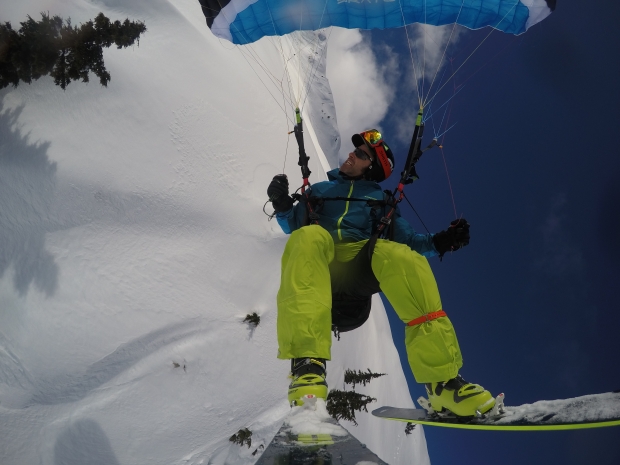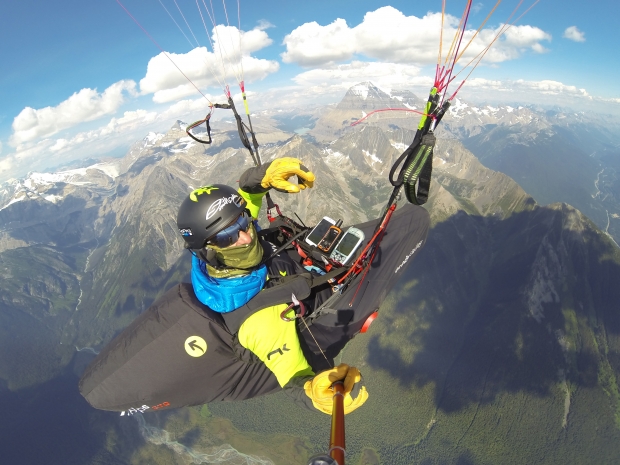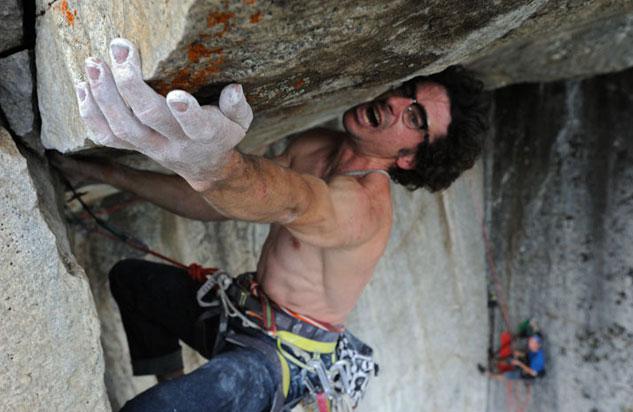
We just got some INSANE news- our passion project from last year “500 Miles to Nowhere” has just been chosen a Finalist at this year’s Banff Mountain Film Festival. The Banff Film Festival is the crowning achievement of any adventure film, and is by far and away the biggest and most prestigious adventure and mountain film festival in the world. Each year, the films travel to 40 countries reaching more than 390,000 people at over 840 screenings. So the Cloudbase Collective will be heading to Banff this November and we hope you’ll join us either in Banff, or catch the film as it travels the world!
The things we carried

Perfect spot for a high alpine top land and camp- Photo Pablo Durana
Will Gadd and I just completed what we believe to be the longest connected track log that has ever been flown. About 650 kilometers across the Canadian Rockies to the US border. One rule: all forward progress was made in the air. Most of the line had never been flown. All up it took us 35 days to complete, with two long bouts of bad weather that shut us down completely for more than a week at a time. A great deal of media will be out shortly documenting the journey, that is not what this essay is all about. I’m still too frazzled, thrilled, shocked, and exhausted to put into words what the expedition meant. I haven’t even begun to look back and process the risks, the rewards, and ultimately what comes down to a lesson in humility. We pressed awfully hard to make it happen, often in desperate terrain and desperate conditions. You can’t get away with that too many times without serious consequences. But we made it whole, safely, in one piece and one thing I have had a moment to reflect on is how much we relied on our gear. What worked, what didn’t, what we’d do differently. Will is also going to write up an essay on gear as well as the ethics of “vol biv”, which I look forward to reading very much, as I learned on this trip that we didn’t always agree, but he was always right, and he has been an incredible mentor- his knowledge, skill and approach are incredibly valuable to the human flight community.
If you don’t fly vol-biv, this article may not make most exciting reading. But if you play in the mountains; on paragliders; on foot or on steep walls; or any other form of alpine travel this may be of use. I spent nearly 3 weeks packing for this trip, laying everything out again and again looking for places I could cut an ounce here or there, making sure I had everything I needed to be self-sufficient. Finding the right balance of things needed vs comfort vs weight when everything needs to ride on your back on the ground and in the air is challenging.

Light(ish) and fast was the goal when we weren’t in the air- Photo Jody MacDonald
For transparency, anything marked with an * was provided by my sponsors.
My pack weighed exactly 60 pounds at the start. Will’s was a couple pounds lighter, owing to using the Ozium lightweight harness (more on this choice below). I cut nothing during the trip, in fact I added a touch with a better sleeping bag as it got pretty cold at the end. This was with 4 days of food (details below), all gear, and no water. Luckily there was water or snow everywhere on the expedition, so we never had to carry more than 3 litres. We top landed nearly the whole trip and were able in almost every case to take off from the same place the next day (or the next flyable day), and because of our rule of no forward progress unless we were in the air (we could go down, up, or back to reprovision or find a launch), we didn’t have to cover much ground on foot. Straight line distance from our first launch above the town of McBride to the US border is 620 kilometers. Our flight logs added up to 802 kilometers as we made a detour the first day to fly right over Mt Robson (EPIC!) and had a number of flights where we had to travel north or south to link the track log, or for a number of reasons couldn’t fly the crow line.
ELECTRONICS:
- * Flytec 6030. I thought long and hard on going with a smaller option for my vario, but I love the 6030 and didn’t want to rely on a bluetooth/other device option.
- Android phone running Earthmate APP (for the Delorme Tracker) and XCsoar for maps/igc log
- * Delorme Satellite Tracker. Once we got these running they were amazing. I’ve always used SPOT. I could write a whole article on the negatives of SPOT. Horrible customer service, horrible website, and their app for sending text messages (SPOT CONNECT) is a miserable piece of junk. Enough said. So I was psyched to try the Delorme. Much more expensive service than SPOT, but having the ability to text to another device, or cell phone, or someone’s email really increased safety and our ability to track one another. We had 4 devices- Will and I each had one, our ground crew had one, and the production crew had one. When you send a text message, the recipient can click on the message and see exactly where it was sent from. It pairs via bluetooth to your phone’s app so you can use your phone to send messages instead of the very un-ergonomic, very old-school push buttons on the device itself. So we could literally be in the air, pop open our Earthmate app, and send a message to the production crew that we were going to land soon, or that we were ok- and they would immediately know right where we were. So a lot of positives. But it does have some downsides. The first is that it took us hours, and HOURS of work to set them all up. Annoying things like the topo maps have to reside on your phone’s memory rather than an external mini sd card (ie you can’t re-route where the app looks for the maps if you store them somewhere else). Really it should be a one page simple set of instructions- do this, then this, then this. But to get there took watching videos, figuring out this really archaic contacts sync, figuring out a world of things that should have been easy that were not. Really to use the device efficiently you’ve got to use the app that comes with it- which is paired via bluetooth. But unfortunately ever 3-4 times you go to use it this connection fails. Even though it says it’s good. The only fix that consistently worked for us was shutting down both devices and rebooting. Time consuming and frustrating, but still- the positives far outweighed the time it took to set it up and the techy problems that arose, and I’m sure the company will get these issues solved.

Charging instruments with the NocoXgrid- Photo Pablo Durana
- Yaesu Radio and * Thermal Tracker Push to Talk (PTT). OK this one is really important. I don’t like radio chatter and neither does Will, or in my experience any good pilot. But sometimes it’s necessary, especially when you get separated. People listen up- get a PTT system that WORKS for crying out loud. Pretty much every time I’m in the air there are pilots who have shit radios or that you can’t hear because their PTT systems suck. I’ve had my Thermal Tracker PTT since my first days flying 8 years ago. THE SAME ONE. I am constantly told how clearly people can hear me. Get one.
GEAR:
- * Niviuk Peak 3. I love this wing. It carried me 387 kilometers last summer on the record flight across Idaho and Montana, and it has carried me over 5,000 kilometers this season. There is no other 2 liner even close to it on the market. It’s a 2 liner that is mellow, safe, easy to fly, with tons of passive safety. A low end EN/D that for me at least, covers a very wide spectrum. A bulldog into wind, wicked capable and predictable in nasty lee conditions, with all the benefits of being a two-liner so you’re constantly in touch with the wing. But with none of the sketchiness of a comp wing.
- Woody Valley X-Alps GTO. Not the lightest vol biv harness made, but for this expedition for me it was perfect. In Europe you can get away with a super light-weight X-Alps style harness, but not in the Rockies. Will really liked his Ozium, which is half the weight of the GTO, but it was looking pretty beat up by the end of the mission. With the back/seat pad removed I had PLENTY of room for all my kit, didn’t effect performance or comfort at all and it all fit in my small (100 litre) Advance Comfort bag, which I couldn’t believe.
- * Smith Optics Maze helmet. Love it. Comfortable, warm, and the lightest certified helmet on the market. Pair this baby with the Pivlock shades, you’ll be all set.
- * Black Diamond Equipment Hilight tent, Trekking poles, Guide Gloves and ReVolt headlamp. All of the gear I got from BD was awesome. The tent is a single layer light weight assault tent. Minimal but uber comfy and man I put it to the test. We had some horrific weather on this trip, and putting this tent up in a few seconds and staying dry made life pretty awesome. Trekking poles I never fly without, and the Revolt was cool to be able to recharge in the field rather than bringing extra batteries. The only thing that didn’t work out was the Guide Gloves, but that’s because they were just too big for my brake toggles, the gloves themselves are awesome, REALLY warm and will be epic for backcountry this winter, but just a bad choice for flying.

Top land, camp, take off the next day. It doesn’t get much better than this Photo Pablo Durana
- 6 litre Dromedary. 3 litre Camelback. Necessity.
- * SteriPen “Freedom” UV water purifier. This little baby is KILLER. I first came across SteriPen last year at the OR show. I couldn’t believe they had come up with something that could treat water that was so small. Well the Freedom is tiny! It’s barely bigger than a lighter, weighs about the same, is rechargeable and WORKS! No more messy, heavy filters, no more nasty iodine. Very cool device.
- 20 degree Western Mountaineer down sleeping bag, and a silk liner. Ok, liner was a bit much, but I get pretty damn smelly and I just like the comfort so am willing to carry the tiny amount of extra weight. I started with a 45 degree down bag, but it wasn’t enough.
- Klymit Inertia X-Frame sleeping pad. At 9 ounces, this award-winning inflatable pad rolls down to the size of your hand and hardly makes a dent in your gear bag, but makes a nice difference in comfort. In fact it’s the lightest pad in the world. We can always sleep on our wings…but this is a pretty nice touch.
- “Herbal Armour” Bug spray. I chose this one after reading a ton of reviews and wanting to find a non-DEET alternative. Worked great.
- Bear Spray
- Leatherman “Skeletool”
- Small wing repair kit– various bits of line, super glue, nylon, needle
- Sunblock. I like the Beyond Coastal brand
- 50′ 4 mil p cord (so I could get down from a tree landing)
- External Condom catheters and tubing (for peeing in-flight)

Laden- Photo Pablo Durana
CLOTHING
- * Patagonia ultra-light down hoody, ultra-light Houdini Jacket, Merino Long underwear, velocity running tights, board shorts, ultralight merino socks, t-shirt. All worked perfectly, as they always do. I added a soft shell jacket a few days into the trip. Will flew in soft shell pants the whole way, but I prefer short and long underwear unless it gets really cold, but my pod was a little more burly than his, so I could get away with less.
- Buff for face protection
- Salewa Speed Ascent GTX shoes. God I labored over this decision. I bought two pairs of trail shoes from my local shop, another two pairs of Salomons from Zappos, and in the 11th hour Salewa sent me the not-even-released Speed Ascent’s. I left for Canada with 7 pairs of shoes in my spares box. Right out of the box I thought they were going to be too stiff in the heal, but I put some hard miles on these shoes and they were perfect. Stiff in all the right places, supple in all the right places, stable, sticky, dry, overbuilt but in all the right places. Goretex outer layer but not too hot. And amazingly lightweight.
BATHROOM KIT
- sawed off toothbrush, one string of dental floss, blister salve, travel toothpaste, chap-stick, cash
KITCHEN/FOOD
- Jetboil stove. Will and I both labored over our stove. Typically I don’t bring one on bivvy trips and just make a fire, but with things being so dry and Will convincing me that we would need fire fast in many cases, we both went with the JetBoil. Compact, efficient, super easy to use and very light compared to most other stoves. I was really happy with this stove, and didn’t bring an extra cup or anything- I just used what comes with the stove. Doesn’t need a lighter to light. Heats water in seconds. I was getting 5- 6 days out of one canister, which was a couple full boils for breakfast and a couple for dinner. Downside is you can’t really cook in it. It’s just for boiling water (ie dehydrated food, instant coffee, etc.). But oatmeal and ramen and that kind of thing- perfect.
- Breakfast was Starbucks “VIA” instant coffee and instant oatmeal for both of us. Lunch was a combo of a lot of snacks that we would eat in the air. For me, a healthy supply of Pocketful almond butters, which I can’t live without and then some combo of chocolate, seaweed snacks, wasabi peas- just a bunch of stuff I found at the market.
- Dinner was mostly dehydrated food, but the best BY FAR and something I would not leave without in the future was the new Patagonia Provisions smoked salmon. Combine this with some ramen or a Tasty Bites Indian curry (the Tasty Bites Indian heat and eat meals are WAY better than the dehydrated backpacking food that really just sucks) and it was just heaven. Tea and plenty of Emergen-C packets.

Going BIG. Photo Pablo Durana
SPARES
Down in the truck Will and I both had a couple big bins of extras. Spare wings (there are a LOT of trees on this route!), harness, reserve, batteries, back up radios, varios, chargers, trekking poles, hand warmers, condom catheters, wing repair kits, sunblock, clothing, and food. We each packed 4 days worth of food in numbered Zip Lock bags so we could just grab and go, and not have to deal with packing or forgetting something en-route.
It was the most radical journey either of us have ever done. We made a great team, I think we did it in style and we definitely gave it everything we had. Huge, huge heartfelt thanks to ReelWaterProductions and Red Bull Media House for believing in us and for giving us the opportunity to fly this insane line, and not completely losing it when it took 35 days instead of 2 weeks!

Launching over Kinebasket Lake, Monashees- Photo Pablo Durana
RELAX- Red Bull Adventure’s new Alaska Video
Defining Adventure with Will Gadd across the Canadian Rockies
Many months ago Nick Greece contacted me about something that has increased my blood pressure since the words left his mouth. Flying across the Canadian Rockies. Yoyo. Banff. Jasper. Bugaboos. Hulking glaciers; massive steep mountains; vasts swaths of DEEPness; grizzlies; mosquitos the size of hummingbirds; going farther in the air than anyone ever has. He’d been contacted by ReelWaterProductions, who specialize in filming impossible missions in impossible places. They had a budget, they just needed a “protagonist”, and preferably two. And to sell it to the client, it needed to be a record. Farther, deeper, never been done…
Vol Bivouac (fly camp) style adventures seem to be all the recent rage in this rather off-route, deeply addicting fringe sport that a friend recently pointed out quite eloquently as “ridiculous”. Flying plastic and strings hundreds of miles without an engine, everything needed to survive on your back. People keep going farther and farther. The French team of Thomas Punty and Nelson Defreyman have flown, hiked, bicycled, and hitch-hiked an absurd distance this year from Alberta to somewhere in New Mexico. Dave Turner soloed 1300 km from Nice to Slovenia across the Alps. Stefan Bocks cruised 1,000 km across Central Asia. Our own team flew close to 800 km across the Sierras to the Oregon border. Some of that same team hiked and flew well over 1,000 km across India and Nepal. Luc Armont set the stage years ago doing a similar length solo in the Himalayas. Tom DeDorlodot and Paul Gushlbauer were attempting an 1800 km hike and fly route in Europe and were over 1,000 km’s in but were stopped when Tom had an unfortunate crash just days ago. But to my knowledge all of these trips have one thing in common: to a large extent they are backpacking trips. When the weather is bad and we can’t fly, we hike. The ultimate example of this style of travel is the Red Bull X-Alps. A suffer fest like no other. Racing across huge mountains on foot and in the air.
So, in order to break the “record”, all one really has to be willing to do is hike farther than anyone else, and at some point fly. There aren’t really any “rules” that our tiny community of adventure pilots is following. What is allowed, what isn’t? I was pondering this very question, asking myself what I would be willing to do for this film when Will Gadd quickly solved the dilemma. Leave it to a former national champion, former distance record holder, world record ice-climber, and hands-down one of if not the best mountain athlete in modern times to quickly come up with a solution. What he calls “the truest and purest paragliding adventure that has ever been done.” This Friday Will and I will approach vol-biv paragliding across the Canadian Rockies in a whole new style. Only one rule: any forward progress must be on the glider, to create a continuous flight log. We can hike back, we can hike up and down, in fact we will need to- A LOT, in order to reprovision (we can only carry 3 days of food), but to move forward, we have to be flying. If we are successful, to our knowledge it will be the longest linked paragliding trip that has ever been done. We have 3 weeks to accomplish the goal, the US border.
We have our protagonists. Two guys who have never met. One was competing in the X-Alps before the other had even had his first flight. One had broken the North American Distance record before the other even knew paragliders could be used to travel. Two guys who have lived through some pretty epic adventures by air, water and dirt using skis, kayaks, sails, ropes and wings are about to set off on what be our wildest expedition yet. I’ve been studying the route for months, and that adrenaline kick I got after Nick’s call has if anything only increased. My crack is flying deep lines, but this one is a whole new kind of DEEP. Landing options in many cases don’t exist. Very few roads, more bears than people, rivers with no bridges, and a LOT of area that no one has ever flown. Excited? Yes. Nervous? Yes. A little scared? You bet.
For the past two weeks my living room has been an explosion of gear. Lists, checks, lists, checks, calls to sponsors for more stuff, trimming, lists, repacking, lists, repeat. Due to the remoteness, inevitable bad weather, bugs, bears and fire risk we’re both taking a lot more kit than I’d like to, or ever have before. But I think I’ve finally got it down. If I’ve missed something, my back will thank me.
In this photo:
- Niviuk Peak 3 (not in photo another one as back up, in case I land in a tree or river or…)
- Woody Valley X-Alps GTO harness (back protection removed). There are lighter and smaller, but I need the space, and we need durability
- 3 days food: Patagonia Provisions smoked salmon (we don’t have to suffer that badly), oatmeal, two dehydrated meals, instant coffee, tea, ramen, plenty of Pocketfuel, and something new I’m trying called Le-Vel Thrive that is a huge cocktail of vitamins, natural stimulants and minerals as we’re going to be operating on little sleep and hiking absurd vertical and I can’t afford a cold.
- Smith Optics “Maze” helmet. Lightest certified helmet in the world. And their RADICAL Pivlock shades- interchangeable lenses, weigh nothing
- Black Diamond Revolt headlamp, Ultra distance trekking poles (SO important), HiLent tent (part of their superlight series), Guide Gloves. Normally I would use a bivvy instead of a tent, but hanging out in the rain or battling off hungry mosquitos…
- Klymit Inertia X-Frame. Lightest, smallest thermarest in the world
- Salewa Speed Ascent GTX shoes. These bad-ass shoes just got delivered yesterday. They won’t even be available til April, the official shoes of next year’s X-Alps.
- Jetboil “Sol” stove
- Thermal Tracker PTT for easy radio communications with filming crew and Will
- Patagonia ultra-light down hoody, ultra-light Houdini Jacket, Merino Long underwear, velocity running tights, board shorts, ultralight merino socks
- 100′ 4 mil climbing rope (in case I land in a tree)
- 6 liter dromedary (for water)
- 3 liter Camelback
- XGrid 4 watt solar panel + battery. We also have a 9 watt version, but I’m hoping Will and I can use these little ones to recharge all our instruments. More robust than the GoalZero stuff, and in my testing, works much better.
- Yeasu Radio
- Flytec 6030 vario (6020 back up)
- Condom catheters (3) plus tube
- Small wing repair kit (nylon, lines, needle)
- Bug spray
- Bear spray
- SteriPen. Really excited about this. Tiny, weighs nothing, can be recharged with solar in the field, guarantees us safe drinking water.
- Leatherman Skeletool. Lightest multi-tool on the market
- GSI lightweight flask (for whiskey)
- lightweight bath kit: anti-chafing balm, toothbrush, toothpaste, spork, floss)
- 45 degree down sleeping bag + 10 degree liner
- Go Pros, lots of GoPros and a bag of mounts
- Satellite phone (not pictured)
- Delorme Tracking device (not pictured)
- Hansen custom Orthotics (not pictured), keeps my feet happy:)
All up: Dry weight (no water) exactly 50 pounds. With water (10 liters), 72 pounds.
It all starts August 1st. We’ve got three weeks to make the border. But we can only get there by flying. I imagine the adrenaline I’ve been feeling for weeks is about to get a wee bit more intense.
Stupid Lines in the Stupidly Pretty
“It’s just you and the elements. You’re trying to realize your own potential in a place where no one sees, and no one cares. There’s a purity in that.”
“It’s not the longest line, it’s not the records, really. It’s trying to find an aesthetic line to fly that’s personally inspiring.“–Bill Belcourt, from the film 500 Miles to Nowhere.
I was very tempted to call this post “Balls Deep” in honor of Tony Lang, who started this rather genital based thread after watching my Spot page and noticing that the flight track did in fact have quite a phallic outline. Of course that was not exactly what I set out to do. Coming off 7 straight days of flying some incredibly awesome tasks (including a 204 km send into the Palouse region of Eastern Washington, a place I’ve always wanted to see), but hardly crushing the US Nationals in Chelan I was in a bit of a funk. I’ve been flying a ton this spring and had high hopes to do well enough in the Nationals to maybe earn a spot on the Worlds Team, one of my goals this year. Considering my first comp was exactly two years ago at the Open in Chelan, in retrospect maybe my goals were a little too lofty. The reason I was in a funk was that I was actually taking something so ludicrous as paragliding so seriously. It was the first time since I started flying that I wasn’t over the moon every time I was in the air. Everyone around me was how I usually am- just thrilled to be flying, to be in the air, to be flying with your friends in perfect conditions. But I was making little mistakes each day and getting pissed that I wasn’t making better moves. And being aware of it made it even worse. I kept asking myself- “Gavin dude you love flying, just be happy to be here, to be flying! Who cares about winning?” But I guess all those years of ski racing and my competitive spirit are hard things to squash and the pressure of performing was eating me up.
As the week wound up and a great final showdown between Josh Cohn and Nick Greece to decide the National Champion was slated on the last day (Nick won- way to go brother!), yet another perfect day for flying I found myself dying to go home, to go fly in big pretty mountains by myself doing what I love without all the pressure of start time, race to goal, battles for position. My plan was to drive all night immediately after the awards ceremony as the forecast on Sunday looked epic for a big day in the Wood River Valley. But then Matty Senior and Trey and a few others mentioned that things looked equally epic in the North Cascades. I’ve spent only a tiny bit of time in the Cascades, back in my kayaking days. I remembered glaciated peaks, remote valley, mosquitoes the size of canaries, purple alpine lakes, no roads, and very very few people. The thought of flying there was thrilling, and given it was only an hour and a half versus 11 hours, the decision was easy.
The drive up the Methow valley was reward enough. I could have gone home then and washed away the comp woes and been totally renewed with just that. To realize I’d lived in Seattle all those years and never made it over there was a bit shocking. A reminder that we often work so hard to travel great distances to experience the world when the best kept secrets are right in your back yard.
Bill Morris gave us a short and sweet site brief that basically reaffirmed what you could see quite easily. Don’t land out, and there are very few places to land. Typically pilots follow the road up to Washington pass then turn around and come back. Once you leave the Methow there was apparently one bail-out meadow, and otherwise you would have to land on the road. “And what about flying out towards Stehekin?” I asked. Bill said that yes, you can do it, but there was no where to land. “It is REALLY, really deep out there.” And if you landed, mosquitoes would quickly take about 15 pounds of blood off you. Copy, let’s go flying!
I punched off Goat Mountain first and I only briefly saw a few other pilots in the first half hour of the flight and then I was alone. I was very keen to get in the air, it was clear we’d already missed a couple hours of good flying and I didn’t want to miss any more. I followed Bill’s advice- got up high over launch, then went on glide towards Tower Mountain north of Highway 20. There was lift everywhere and the winds were light. If I’d been in Europe I would have been thinking “Hammertag”. Bill was behind me somewhere and was asking where I was. I didn’t know the names of anything so I was saying things like “well I’m over these very spiny steep peaks with a lot of snow and it’s totally epic.” And he would reply that I needed to be a little more specific. The whole place is like that!
Off in the distance to my west I could clearly see Mt Baker and to the SW Glacier Peak, high frozen and proud on the spine of the Cascades. Between the two was a smaller top hat mountain covered in thick ice that seemed like a really good waypoint for a possible FAI triangle. I started thinking if I could hit that, then head up to Glacier Peak, then head home- that would be awfully cool. Above 12000 feet the air was smooth and other than getting some seriously rock and roll climbs here and there it was some of the smoothest mountain air I’ve ever flown in. Once I dove across the other side of highway 20 I could see things were getting serious. I split the difference between Black Peak and Mesachie peak and tried not to look down too much and just pressed on to the west towards my goal, Klawatti Peak. If I went down anywhere, it would be ugly.
The lines were incredibly lifty but as I got further and further into the big mountains and more snow I wasn’t getting the big climbs. I dove into Boston peak at ridge height level barely above the ground at 7,000 feet, still hoping I could get up and tag Klawatti. The track log in this bit is pretty interesting, it’s worth a look in Google Earth. Luckily there was enough wind out of the west that I was able to ridge soar in the lee long enough to work back around and out of the killing zone (what I was calling it in my head as it was clear I really needed to get out of here or I would be dead) to Park Creek Ridge where I got a boomer and made the decision to give up on Klawatti and head towards Glacier Peak.
I could see the end of Chelan Lake, and I knew Stehekin was there and I knew pilots had recently landed there. But I wasn’t ready to give up. The only problem was cirrus. A very thick blanket of high cloud was moving in from the south and threatened to shut down the day. If I pushed on, I could get trapped, but for the moment things were still working and I wasn’t ready to give up on my little tour.
So I headed south, not far off the spine of the Cascades. In fact several times I nearly carried on due west, thinking it would be awfully cool to fly across the Cascades, but with the westerly wind and with all the very big dense trees…

skipping along way too low for comfort, but thankfully climbs were found.- Stehekin is over far right
But the cirrus was making it too hard to get to Glacier. There were still big cumulus clouds, clearly it was still working but as I drove south towards Sentinal Peak I lost too much altitude and had to make a decision- go so deep and risk landing in…what? Or, try to make the jump to Stehekin while I still had a chance. I chose the latter, caught a weak but very necessary lee side climb in the valley to allow me to glide to Rimrock ridge and get on a west-facing slope, which I knew would work.
But it didn’t. I tried and tried to get a climb, and I could maintain the ridge by soaring the west wind, but nothing was pinging off. So I would get just enough height to clear the ridge and then jump east to the next one, knowing that there would eventually be a climb. But there never was. By the time I got to the third jump, a mountain called Tolo I was well below 5,000 feet and for the first time, getting pretty concerned. I could see Stehekin off in the distance, but I didn’t think I could get it on glide unless I found a very good line…but over a cascading river I thought that would be awfully unlikely. But I didn’t have any choice, I had to go somewhere. So I went for it.
The backside, in the lee was typical of lee conditions- spicy and unnerving. But it also felt warm…maybe I’d get a climb. And sure enough my vario and my brain started singing and I was suddenly in a drifting ratty but 3M/second climb and a very big smile on my face. And now with altitude again time to reassess. No way I wanted to land in Stehekin. I could make it now easily but then I’d have to take a 4 hour boat ride and then hitch back to my car. The logical thing to do would be to just fly back, but I hadn’t scored the FAI yet and if climbs were still working…there was more to be done. So off on glide again from 12,000 feet across the valley to the south where my phone was saying I needed to get to get the triangle. Pull out a roast beef sandwich, take some pictures, revel in the beauty. This was the place I needed to be. The magic of flight had fully returned, the healing powers of that constant battle of up and down hanging under a modified bedsheet and I was cured.
I couldn’t believe there were still climbs. The ground looked dark everywhere. The sky was a thick gray, but once I got across to the peaks again POW, another climb! Glorious fast climbs that started ratty and turned smooth, sending me to 12,000 feet and beyond. At the end of Chelan lake I got as high as I could, just over 4,000 meters and set off on glide home. The next hour was very hard work and sufficiently stressful but maybe the best end of flight I’ve ever had. Tiny, insignificant climbs of .2 meters a second would keep me alive. Wretched places to land and very long walks out were very motivating to stay in the air. I couldn’t tell how far I had to fly but it seemed like quite a distance. So I just took every little bit of warm air I could, tried to find the best glide and loftiest lines possible and eked along, frisbeeing very very slowly home. Eventually I got on top of Liberty Bell Mountain and right back over highway 20 and I knew that at least if I didn’t get back, I could land on the road. I could see cars and RV’s way down below me on the pass and it made me smile, knowing that while their view was spectacular, mine was heavenly.
In the end the glide back to the Methow was easy. The whole valley was booming in the strongest glass off I’ve ever flown. In fact it was terrifically hard to get down, even spiraling as hard as I could I could only get my vario to register a 5 M/sec descent! Eventually I did land. A couple friends/pilots had been following my spot track and were smiling as much as I was knowing what I’d seen and where I’d gone. Apparently no one has flown some of those areas. Like Bill said later that night- ignorance is bliss!
After I landed I reflected on something I’ve learned so many times you would think I wouldn’t have to anymore. Flying should always be as fun as those first sledders when you first learned. The joy and impossibility of what we do should always be the reason we do it. Always. But try as I might, I’m endlessly chasing bigger and bigger distance, bigger and bigger goals. Go a hundred miles, now you gotta go 150. Go 150, now you gotta go 200. Last summer when I went 240 miles ever since I now want even more. It’s a dangerous and stupid game. It’s a pursuit that is no different than some corporate asshole who wants a bigger house and a fancier car. Pursuits that make you no more happy, no more content. I don’t know a more profound joy than what I experienced on this magnificent day. Like Bill so eloquently said- it’s about finding an aesthetic line to fly that is personally inspiring.
Pushing Hard in the Alps
Since my paragliding obsession began in 2006 the Alps just get better and better and better. I go over every chance I get. Four times last year. Three the year before. The same the year before that. I’ve lost count. It’s always a supreme chase. There’s green grass and trees everywhere for a reason and being at the right place at the right time can be a very tough game. Luckily I’ve got a trick up my sleeve- his name is Bruce. That he’s an Aussie is particularly amusing. He handily destroyed the Chocolate Club on X-Contest last season (for 100K+ flights and is murdering it again this year), racking up over 500 hours in the air before a pretty scary crash in the Sass Fee Valley near Zermatt that he walked away from, but not totally unscathed. He’s got the addiction probably worse than I do but he’s also got a mind for detail which I definitely don’t. I’m not aware of anyone who follows the weather more closely so when I head to Europe I just go where he says to go and it simply works out.
My summer is stacked with paragliding plans which I’m trying to orient around training for next year’s Red Bull X-Alps. I want to spend as much time as possible on the X-Alps route between Salzburg and Monaco pushing deep lines and hopping over cols and summits that demand some pretty attentive flying. Typically Bruce and I attempt FAI and Flat Triangles on proven routes that can easily be found on the X-Contest database and I’m an admitted kilometer chaser, but my mission this spring was to fly creative lines that would connect valley systems that pilots like Chrigel have mastered. And as Bruce will be one of my supporters next year, we also wanted to fly a lot of areas we are not yet familiar with. We foreigners are handicapped big time with the lack of local knowledge. For the Euros the Alps is their back yard and while I believe firmly that flying the Intermountain West is a lot more committing and a great training ground, the Alps reign supreme in its complexity. Each valley has it’s own unique characteristics and challenges, and they are all potentially affected by things happening north south east and west of where you might be and cannot see and feel.
I had three weeks before a planned filming/flying expedition to Iran this May to have another go at spring in the Alps. I got an email from Bruce on April 30th that said, “it’s time for us to get to Fanas”. I was on a plane the next day (flying standby on United makes travel across the pond about as hard a choice as going to the grocery store).
Job one was to retrieve the Niviuk Mobile in Annecy then drive around Geneva and Zurich to meet Bruce in the tiny alpine town of Fanas above Chur, a place I’d always wanted to fly. Huge triangles are done out of Fanas and our first good day looked like a pretty decent shot at something sizable. 30 km into the flight, just after the first turnpoint a Swiss Pilot in front of me suddenly started doing some pretty wild looking acro in a place I thought was pretty questionable for hucking. Turns out he wasn’t doing acro but was in an uncontrolled cascade. His reserve came out just as things started to look pretty desperate and he landed softly on a very steep snow slope and was able to walk down. Just another day in the Alps! I crossed Davos and headed for Chur, battling a wretched headwind and soon found myself in a very steep, tight canyon watching gliders in front of me carry on. Push on into a potential terrain trap or land safely? I landed safely, feeling the gliders in front of me had very little chance to carry on much farther. I went 50km that day, some of them battled for nearly 200. Not a very Chrigel start to Europe, time to dig a little deeper McClurg!
The next day was considerably questionable with a lot more wind and chance of overdevelopment so I launched with Bruce and instead of going for the typical first turnpoint, which most of the other pilots in the air seemed to be attempting with little success I said adios to Bruce and pitched it over the back toward Feldkirk and quickly found myself in a stunning albeit icy arena grabbing some terrifically dynamic climbs. In no time I was running hard for Lichtenstein with very little idea where I was but ecstatic with the decision to just lob into the unknown. In due course a blanket of cirrus shut everything down so I did what is remarkably easy just about everywhere in the Alps- land at the train station and head home.
From Fanas Bruce saw a window in Bellinzona on the border of Italy, at the north end of Lago Maggiore. This is the Italian region of Switzerland where you can thankfully leave the crappy (and incredibly expensive) Swiss “food” behind. Our first flight was a doozy, and maybe the most important flight I’ve yet had in the Alps that allowed me to tie this complex place together. Our plan was to fly along the north end of Lago Maggiore to Domodossola, where we’d cross the border into Italy, then north to grab a turnpoint near Mt Basodino, then head home to complete the triangle. On the way to Domodossola you could easily make out the Matterhorn and the Finsteraarhorn. We were literally one valley away from the Rhone, a valley I’ve flown up and down more than any other in Europe. All those times looking south, wondering what would happen if I just went…that way. Now I knew!
After a low save north of Domodossola a strong south valley wind didn’t allow us to hit the planned turn-point so I headed north until I couldn’t go any deeper then crossed a col and just kind of followed my nose. Bruce was behind me somewhere but we were out of radio contact, then I nearly lost my phone and battery on my flight deck and lost my maps for a full glide which didn’t seem to matter as the maps weren’t helping much anyway so I just carried on, col hopping. The terrain was magnificent and it all felt incredibly deep, but no doubt if you got in trouble you could wedge down into a valley and find a bus or train stop so I just kept pushing on north until I got to a huge valley that seemed to lead back to launch. In the end I flew a magnificently inefficient 165km FAI but anytime you spend 8 hours in the air it’s a terrific day. Turned out the biggest flight in Europe that day (posted) which testifies to Bruce’s remarkable weather skills.
We got 3 more flights out of Bellazona, but all of them were considerably more work with plenty of sketchy thrown in. The most memorable was a huck downwind to the ski town of St. Moritz on an amazingly unstable day where only tiny bits of sun were hitting the ground but was somehow enough to keep us in the air. I landed at the end of the lake in town a few feet short of controlled air space, about 100 feet from the train station, after throwing big wingovers above a crowd of people standing firmly into a strong breeze that I was happy to get out of. Only in Europe! These flights were all enormously rewarding. Day after day Bruce and I were getting some of the best flights posted in Europe, confirming the routing ability of my partner for the X-Alps and increasing my Europe knowledge immensely.
Even though we were trying to avoid the Wallis opting for new sites, the weather brought us back to Fiesch as it always does and I got to have just my second go over the infamous Furka pass with a great crew of pilots including Hucksters Sebastian Benz and Dominique Dusec, two Swiss air Gods who consistently rack up impressive flights in this area. At the end of the day I’d flown a hard-fought 192km. Hard only because of what my flying partner at home calls “school boy errors”. The first wasn’t so much an error but just lack of patience. I got to the Furka well ahead of the group I was flying with and thought we’d go with our original call of a big flat triangle back to Martigny then possibly around to Interlaken. So I tagged the glacier at the Furka, flew back 10km only to hear that Bruce and Co were heading over. So I turned around and got stuck in the pass for 40 minutes of scratching before finally losing patience, knowing everyone was pulling away and just slid through the col a few feet off the deck hoping the backside would give me some room to work. Which of course it didn’t so the scratch fest continued for a very stressful bout before I finally grabbed a decent climb and carried on toward Andermatt. Then I blew my condom catheter off and peed all over my gear and instruments and eventually somehow even my face. Then I decided to try to turn around and head back over the Furka as some pilots seemed to be doing but when I tried to pee again hanging out of my harness I managed to pee once again all over my face and I thought “ok fuck this, I’m just going to go downwind and land!”. But I hate landing so I just put up with being wet and carried on. eventually landing near Zurich. Radical (albeit wet) flying!
From the Wallis we headed east again to Austria to try our luck at Greifenburg, one of the most famous flying sites in the Alps, and certainly THE most for Hangies. The line possibilities from Greifenburg are nearly endless and I made up my mind to try to be creative. We got three solid flights from Emberger Alm, the main launch, racking up a 152 free flight where I tried to do a huge FAI across into the Pinzgau in a strong south Foehn and couldn’t get back; an 88 km flight to the stunning Glosgockner on a remarkably questionable day; and a beautiful if hard-fought 164 FAI where I tried to dismiss the standard routes and just fly hard terrain.
As always, my time in Europe came to an end too early. But it was a successful run. 12 flights in 21 days. 69 hours in the air. Nearly 1300 KM. A solid warm-up to the season, and an astounding improvement on last year’s 5 flights in the month of May.
!
Confessions D’un XC Junkie
The French Magazine Parapente just published a great feature about the record flight of 240 miles last summer from Bald Mountain, to Helena, Montana, shattering the North American Foot launch record on the Niviuk Peak 3. If you read French, let me know if it’s any good!
500 Miles to Nowhere – the Niviuk Edit
The Cloudbase Collective has just released the Niviuk version of 500 Miles to Nowhere. We’ve been working hard on the extended edit of 500 for the Film Festival Circuit in 2014 and thought we’d share some more footage from this incredible project with our friends at Niviuk. We hope you enjoy!
[vimeo]https://vimeo.com/92836853[/vimeo]
Freefall
All photos by Jody MacDonald
Warning: If you have an aversion to doing things a long ways outside the box, this story is not for you. If you prefer a world of rules, regulations and standards, this story is DEFINITELY not for you. This is a story about risk. About approaching things a little differently. Ok, a LOT differently. It involves a King, helicopters, jumping out of said helicopters, flying and friends and pursuing adventure in a linear but very unusual way.
It begins over two years ago. Back then they were two completely different stories, but now they have converged as one so I will tell them as one. I was paragliding in Europe and ran into our good friends Mike and Stu Belbas, who run a paragliding school in the Alps called Verbier-Summits. We were sitting around drinking lattes between flights and they began telling me about Benny Abruzzo, one of their clients from the season before. Benny owns Ski Santa Fe and the Sandia Ski area in New Mexico. He’d done some hangliding back in the 70’s and 80’s and came to Mike and Stu to learn to paraglide. He liked them so much that at the end of his trip he invited Mike and Stu on the Small Bus Tour that March in Northern BC. Benny is part owner of a heli-ski company (Northern Escape Heli Skiing) and the Small Bus Tour was the name for his own personal week-long tour with his best friends and family. The helicopter lands right next to his house, on a lake at the foot of the coast mountains. A 5 minute flight and you are dead center into 7,000 skiable acres that typically gets an 80′ base. Big big mountains and Deep deep snow. So they are regaling me with stories of the Small Bus Tour and then tell me that on the trip Benny tells a story one night about a cabin up high in the Sandias that is kind of like his zen house. He goes there to get away, to think. He tells them that when he goes there he has a big stack of kitesurfing magazines and “just dreams about going on the Odyssey.” Turns out he’s talking about The Best Odyssey, the five year kitesurfing expedition Jody and I ran around the world from 2006 to 2011 (now the Cabrinha Quest). Mike and Stu mention that they know that guy, that they can probably get him on the boat.
So I’m like “guys what the hell! Why didn’t you tell me? I gotta meet this guy!” Turns out he was just over the valley in Chamonix with his wife Sandra climbing. So I hopped in the Niviuk mobile and drove over and tracked him down. It was an instant friendship and an easy deal. I go heli skiing, he goes on the boat. Done.
A couple weeks later I fly up to Alaska to scout something I’ve been dreaming about for some time. Jody’s brother George (not his real name) is a bush pilot bad ass who lives off the grid. Not far from Denali. Has a grass runway right on his property. No one knows Alaska better, no one plays harder. Flying with George is one of the coolest experiences a person can have. Pretty much everywhere you go you are right off the deck. He doesn’t understand why people fly around high. He doesn’t understand why people use runways. With George you land on beaches, rivers, mountain tops. He has floats, skis, or big tires for the changing seasons. People who crash their planes, or get them eaten by bears (seriously, bears eat the canvas and tires off planes up there all the time)- they call George to bring the plane back. Macgyver’s got nothing on this guy.
Back to my dream. I want to bivvy fly the full length of the Alaska Range. 350 miles. I can’t imagine a more remote, desperate or difficult flying line. Big mountains. Lots of bears. No people, no villages, no roads. So George and I are out in the range scouting with his Super Cub, a small 3 seater canvas plane. Day after day we fly out there, and I am overwhelmed at the bigness. Huge overhanging seracs, mammoth glaciers, difficult and impossibly beautiful terrain. We land in some obscure insanely pretty place and I do some paragliding but we can both plainly see that my dream is impossible. We’re assessing two totally different things. I see low cloud base and Alders- endless Alders. If I land in the Alders I’d have to commit suicide. You would never get out. He’s assessing support. For me to bivvy fly across the range I’ll need air support. Food drops. But he wouldn’t be able to get to me and I would never be able to get to him. Then one day we fly through a pass to the northern side of the range. Suddenly everything changes. From a paraglider’s perspective it all works. High cloud base. Plenty of places to land. But from George’s it’s even worse. On the north side of the range there is nothing. No villages. No roads. No place to land a plane. No place to get fuel. He could support me- but not with an airplane. The dream dies.
A year later I’ve had my first trip on the Small Bus Tour, my first time heli-skiing and speed flying out of a helicopter. 7 blue bird days with perfect snow. No reason to expound on this, as you can imagine it was an all-time experience that I will take to my grave.
George calls me out of the blue late one night a month later. “Gavin, we need to buy a helicopter.” I tell him he has the wrong number. I only know two things about helicopters, both of them learned on said heli ski trip. They are expensive, and they are very hard to fly. But George says this is a small helicopter and we can buy it for cheap. And he reminds me that he is George- he can fly anything and he’s already certified to repair helicopters so all he’s got to do is learn to fly it. And then he hits me with the clincher. “Gavin, we’re not getting any younger.” A mull it over for a few weeks and find that I am getting dangerously close to pulling the trigger so I finally call Jody (I was back in Europe paragliding at the time) hoping she will talk some sense into me. She replies “stop being an idiot, can you imagine the crazy shit we will do? Get the damn thing!” So…we push retirement back a bit longer and buy a helicopter.
Last fall Benny and his wife Sandra join us on the boat in Polynesia and I learn that Benny is actually the King of New Mexico. Benny has a heli-skiing operation and I get to go with him. He can be whoever he wants! So Jody and I go visit the King in Northern BC a few weeks ago for my second Small Bus Tour. All the usual suspects are in attendance. People I’ve grown to love. People with huge hearts and a penchant for an unreserved approach to having fun. Each day we throw speed wings and powder skis into the heli and head up into a winter wonderland to fly and ski until our legs give out.
Then we shuffle gear in the Vancouver airport and head back up to Alaska to play with our new toy. George flies anything- planes of all kinds, paramotors, paragliders, speed wings. Helicopters are in fact very hard to fly, but he’s picked it up in no time. When we arrive we start to plan what we’re going to do with our time. We are shooting a trailer for the big bivvy trip, so we need to do some filming. We develop a shot list. We’d like to do some speed flying, we need to shoot some footage of the Alaska range, I’d like to figure out how to D-Bag out of a helicopter (jump out with a paraglider).
We’re talking about all of this and George says, “hey do you want to go skydiving?”. He had purchased a parachute on eBay this winter. It arrived in the mail packed and he got his buddy Jake to take him up to 10,000 feet in his plane and he jumped out and free fell 6,000 feet. He’d never done any skydiving before. It went well so he and his son packed it that night with the help of YouTube and he jumped again the next day. That also went well. He’s telling me this story and I’m laughing as hard as I think most people would be hearing this story. Crazy right?
So he asks me if I want to go skydiving. I say sure, that sounds fun! So we get out his rig and we pack it (again using a YouTube video). Then he asks me what I remember about skydiving? I did a tandem jump in California when I was 18. 24 years ago. I don’t remember much. Something about “banana”?
“Exactly!” he says. “That’s all there is to it. You jump out, play around for 5,000 feet, then get into banana! Just keep your head, don’t panic or do something stupid and remember banana. Look- here’s the reserve over here if something goes wrong, pull that.”
We decide to do it with the helicopter. I read some scary stuff about people jumping out and getting their drogue shoot getting pulled out as they are exiting the ship and lines going into the tail rotor and everyone dying. So we do a dry run on the ground, go over the exit procedures. Set up the GoPro cameras. Decide that I will jump out backwards so I can shoot the helicopter as I drop away from it. Jody keeps asking me why I’m not nervous? People get in trouble because they panic. They freeze. I like crazy, I love adrenaline. Assuming we’ve packed the chute approximately correct this is all going to work out just fine. I’m going to jump out, get to terminal, figure out how to move around, get into banana, maybe do some tricks and spins if I can figure that out and keep an eye on my altimeter and pull at 3500 feet. If that doesn’t work I’ll pull my reserve. Simple.
We fly up to 7,000 feet and I get out on the skids, take a look around, get the thumbs up from George and look down and finally the heart ticks over a bit faster so I look back at George and he points as if to say…ok man, now’s the time. And I jump. I fall back and lock my head onto the helicopter to get the shot then roll over onto my stomach, find banana, look at the altimeter, realize I’ve still got a lot of time so I pull back my hands and dive down at the Earth and feel things go VERY VERY Fast, then pull back into banana, figure out that I can move a little with my hands and do some fast circles back and forth. Do another dive cause the first one was crazy good fun. Then I pull back into banana and pull the chute.
I agree with George after it’s all over. Skydiving is super fun, but it’s really just a novelty. Something to do to get your kicks every once in awhile. I can’t understand why anyone would do it over and over again. But then most people can’t understand why someone would want to paraglide hundreds of miles over big mountains either. I just find the latter is just way way way more intense and dangerous and I find the sustained energy and mindfulness required to do it more addicting.
We spend our final days in Alaska seeking out places to fly and testing out procedures with the helicopter. There are so many small pieces of this huge puzzle that are going to have to fit together perfectly for the expedition to succeed and all this practice is crucial. But we leave plenty of time for fun as well and on our last day we take the heli out to the Knik Glacier and set up a slack line in an amphitheater of ice. Falls hurt a bit more than usual, but…well- can you imagine?

The Alaska Range Expedition will cover a lot of ground just like this. See that little dot down there? That’s me.
For now the Alaska paragliding expedition remains a dream. Something tantalizing that seems a long ways away. Another year of planning is required and even then a whole lot of things need to fall in place. But George is right, we’re not getting any younger.
Business Insider- This Photographer Brought Her Camera Paragliding, and the Images are Incredible
The Business Insider just posted a huge feature on Jody’s MacDonald’s paragliding photography, shots taken in Mozambique, Namibia, Madagascar, Maldives, Tonga, Himalayas, Scotland, Europe, Sierra Mountains of California and a LOT more. Check it out! A stunning trip around the world from a birds-eye view (click the photo to see the feature):