Chinks in the Armor- The Red Bull X-Alps Reality

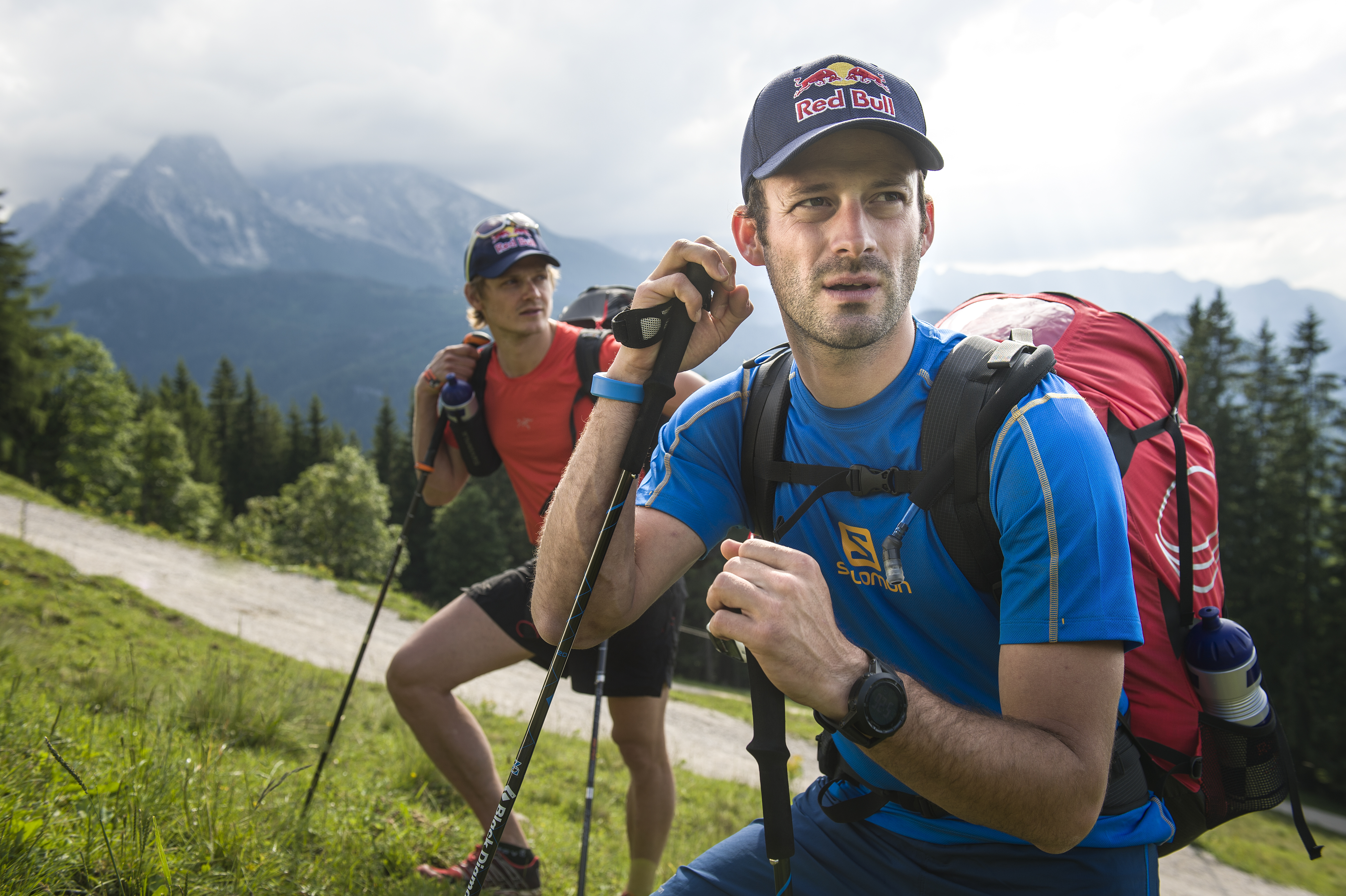
On the set with Red Bull near the Zugspitze (TP4).  All kitted out!

On the set with Red Bull near the Zugspitze (TP4). All kitted out!

I arrived Europe May 8th, about the same time an article came out in Cross Country magazine summarizing a few of the athlete’s approaches and how they have trained. The title of mine was “The Cocky American.” They weren’t being divisive or derogatory, they were using the exact words I’d fed them. I had said in the interview that even though I was a rookie; I don’t live in the Alps (home court advantage is something most pilots say is impossible to overcome); I’m 43 and well past my used date in terms of my professional athlete years; and I haven’t been flying nearly as long as most of the pilots in the race, I am by nature confident but more than than I feel like I’ve done everything I can possibly do to prepare, and I expect to do well.  I’ve got an awesome team, one of my supporters Ben Abruzzo has turned my body into a machine through months of months of continuously pushing me to get stronger, faster, and more capable of suffering.  In short, I arrived Europe physically and mentally ready and really excited to get to the fun part- learning and flying the hardest course line in the races’ history.

Getting ready to launch

Getting ready to launch

It’s been a month to the day and I wish I can report it’s all been a merry tryst through the Alps, that I feel great, and that I’m still the cocky American. Much of the course line has been flown.  A ton of it has been walked. Many, MANY launches have been re conned. Bruce Marks, my official supporter and myself have studied, refined, learned, altered and made a lot of adjustments to our plan.  And when the weather has been bad, which it has for the most part until the last week the physical training has carried on without a hitch. My body still feels strong, even though I have punished it harder this last month than at any other time in my life.  All good things.  A lot to be thankful for, a lot to feel confident about.  But truth be told until we finally got some decent weather this week and I was able to rip off a few proper flights and get my groove back I have been anything but the cocky American.

2015-06-03 16.07.59

A very good day of flying between TP 3-4, on a deep line


For one it’s been a lonely road. Without a driver I keep getting separated from the Niviuk mobile, which is stocked full with the foods and supplements I’ve come to rely on. At times I get separated for 4-5 days, which means walking for 30, 40, or 50 k and a lot of vertical without proper food really challenging. The van has all of the rollers, bands and balls I need to mash my body every night so it’s ready to perform the next day. I hike up to launch solo, fly solo, land solo and then prep for the next day solo. Sometimes I reconnect with Bruce and the company is fantastic. Let’s be honest- it’s nice to have friends around. But for the most part the training has been a solo affair. Pretty much every single one of the flights I had the first two weeks here were WAY sketchy, ending in terrifying landings in strong winds.  Exactly the same conditions we can expect for the race. Usually I relish conditions like this. But I wasn’t. I was scared, and getting more scared. Was I off my game? Why did I keep looking at my reserve handle? Why was I constantly leaning forward, a sure sign I’m nervous as hell? What was this new found nervousness and distrust in my abilities? Was it simply that I needed a break, or was it something more sinister?

I’ve been interviewing pilots for the podcast who have been in the game a lot longer than I have. My mentors, my confidants, my friends, and guys I trust. Over the past years they have often given me that wise look like “hey man, this is supposed to be fun, you don’t have to push so hard.” They have all gone through periods where they have had to back off, turn down the volume. I’ve never experienced this in my flying career but there is no doubt it will come as it does for everyone.  My own supporter, Bruce Marks had a really scary crash two summers ago in the Saas valley and is still trying to overcome that dark head space.

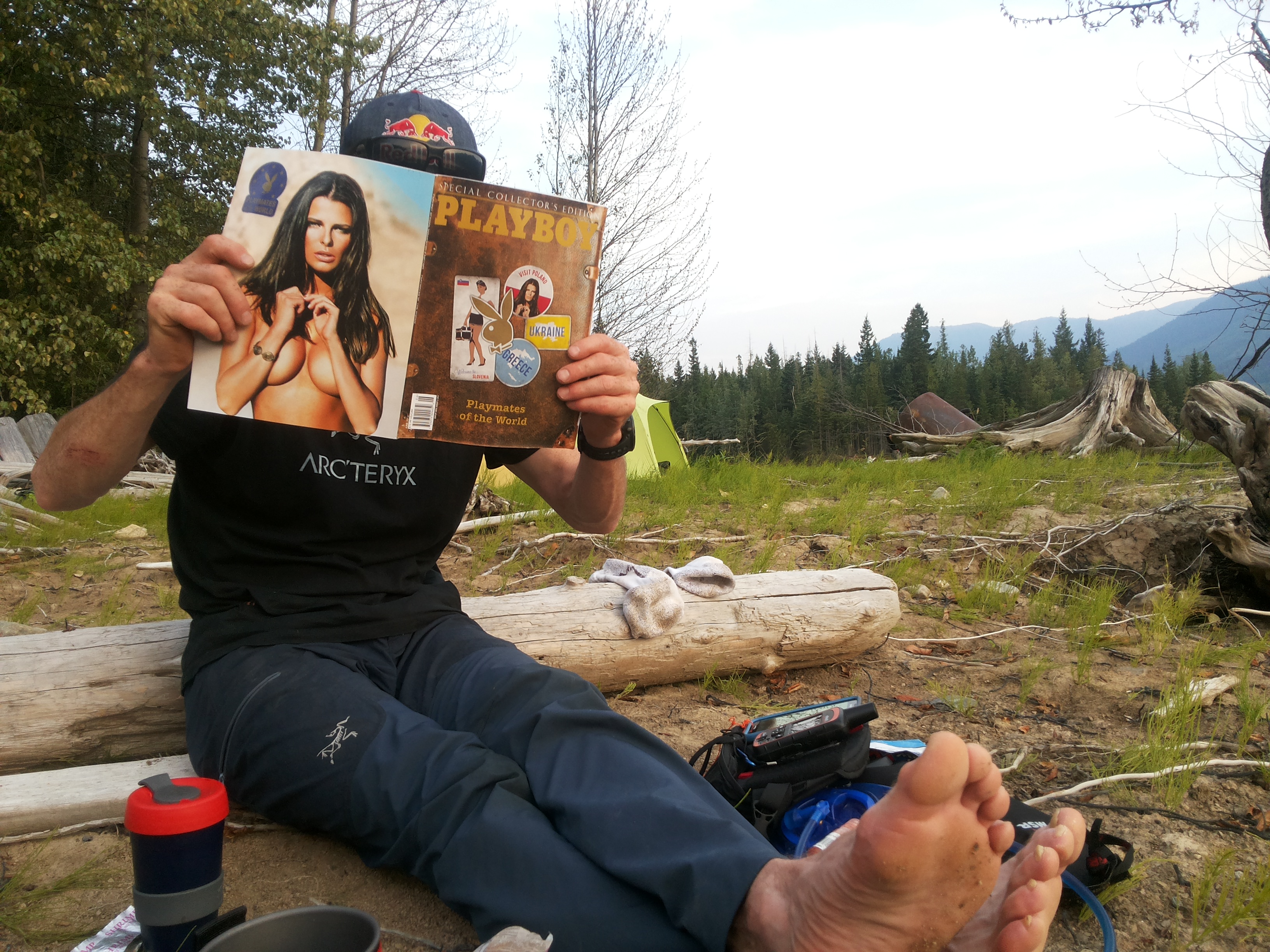
Not a bad place to camp for the night

Not a bad place to camp for the night

Every morning I head out and my head says no but my body says yes. The sweating starts, the cursing follows but the body just does the work. “Shut the fuck up head!”  I keep saying, but it keeps grunting relentlessly. “I’ll shut up when you take a break!”  But I don’t feel like I can afford a break.  Just a few more weeks and that gun goes off in Salzburg and there won’t be any more time to prepare.

Scouting

Scouting

But finally this week our relentless bad weather broke. Instead of terrifying flights I kept getting long flights where everything made sense. No huge surprises, no unreasonable wind, no excitement beyond the normal excitement of being in the air, participating in the absurd. The kilometers racked up and I returned to taking the deep lines that I love so much. My smile returned. My heart patched up a bit. One day I hiked 8 kilometers and 1300 meters vertical only to find I lost my helmet on the way up.  So I walked back down. And then back up. And then all over the place. And then back down. And then back up again. I racked up nearly 50 km going up and down that fucking mountain, nearly all of it without food and water.  Finally I gave up on the helmet and launched in very ratty sketchy conditions and flew back to town where I’d started the day, cool as a cucumber.  A miserable day…and a perfect training day.  After I ate three dinners and two desserts and looked in the mirror at my sun burned unkempt face and my rotten shirt that I’d been wearing for 5 days I noticed a funny smile on my face.  I felt GOOD.

Flying course line between Annecy and Mont Blanc

Flying course line between Annecy and Mont Blanc

Episode 2- Matt Beechinor (the Glider Podcast)

Really excited about this second episode with one of my mentors in the big XC game, Matt Beechinor, aka “Farmer”.  When he flew 193 miles in 2012 from Mt Baldy in Sun Valley I decided my choice to move to the Wood River Valley later that summer was about the best decision I ever made.  Matt has been flying for almost 20 years, is the best tandem pilot I know, is an amazing instructor, guide, and a Jedi in the air. In this episode we hear about a couple of amazing saves, what the “alien world” is, how Matt approaches risk, how to thermal better and how he has become one of the best gliders in the business.  Enjoy!

Farmer soars the Mulanje Massif, Malawi

Farmer soars the Mulanje Massif, Malawi- photo Jody MacDonald

Support the Podcast

A buck an episode, that's all we ask

If you like what you hear, please consider becoming a subscriber to ensure our high-quality content continues. You can also help contribute to a healthier, greener planet through our partnership with Our Forest. See our donation and subscription options here.

Listen to the Podcast

Listen to us on all the most popular podcast platforms:

Show Notes:

  • Matt discusses his history of paragliding, including some pretty hairy learning experiences in the Wood River Valley
  • Matt discusses using an “ESP” maneuver to get out of a bad cravat in the Sierras
  • Matt discusses thermalling techniques and the importance of nailing wing overs
  • Matt discusses the US team, competition, and how to glide more efficiently


500 Miles to Nowhere in 30 Degrees Magazine

Jody MacDonald once again captures some stunning images of our vol biv expedition in Utah and Wyoming in 2014, which culminated in the film “500 Miles to Nowhere”.  It helps if you read French, but even if you don’t, the images will give you goose bumps:)


[vimeo]https://vimeo.com/104930744[/vimeo]

A life uncomplicated

“The hardest thing in the world is to simplify your life.  It’s so easy to make it complex.”  -Yvon Chouinard, from the film 180 degrees South by Chris Malloy.

I was sitting with a good friend of mine this week, Gerry Moffatt whose winter has consisted of nursing a severely broken leg back to health. In a dark instant this December his life got really, really simple. Since then he has had only one thing to focus on- healing. It was the not the winter he anticipated, nor I’m sure would he want to go through it again, but the simplicity of his task is something many people would envy if not for the horrendous pain. My life this year has been in some ways quite similar and while comparing the two is preposterous that’s what we found ourselves doing over a mountain of eggs and coffee. Inevitably at these regular breakfast chats that me and Gerry cherish we talk in length about how my Red Bull X-Alps training is going. He asked me a question this time that I thought had an obvious answer. “Would you do it again?”

Some "hard" training goes down in Northern BC

Some “hard” training goes down in Northern BC

I answered immediately: “Fuck No!” Training for what is billed as the hardest adventure race on Earth has consumed my every move and thought for the last 7 months, and I’m sure will only get exponentially worse until the race starts July 5th. And I mean CONSUMED. I eat; I train; I eat and eat and eat; train and train and train; make lists that have no end; and sleep whenever possible. My heart rate monitor has become clothing. Metrics are studied, diets are adapted, routes are analyzed. This is my life. Unless you have competed in this race, or are a rookie like me this year I promise you can’t possibly imagine what goes into this kind of campaign. On January 1st I cut out alcohol completely in order to sleep better and recover faster. I like beer, and I like scotch. Not an easy task, to give up the things you love, but when that gun goes off in Salzburg I don’t want any excuses.  When the race ends, if I do poorly I don’t want to look back and wonder “God, if I’d only done X…”  So I’m doing everything I can to prepare.

1 of 9 stations that I call "my hell workout"

1 of 9 stations that I call “my hell workout”


To complete the race we will gain the altitude of Everest four times between Salzburg and Monaco. By foot, with our packs, which consist of our gliders, harness, helmet, emergency gear, clothing, water, food and instruments- about 12 kg on average over a course that is the hardest in the races’ history. Even if the weather is good and we fly a great distance of the route, we will cover an average of two marathons a day on foot- for two weeks. In the Alps, which are not known for their flat terrain! Every Monday my trainer, Ben Abruzzo, an ex-army animal who has competed in other similarly suffer-oriented adventure races like the Death Race and Tough Mudder posts my training week on Google Docs. My job is simple:  put my head down and do it. Each week is harder than the last.

This guy has been getting some pretty funny looks this winter around town

This guy has been getting some pretty funny looks this winter around town

But as soon as I said there was no way I’d do it again Gerry picked up on a look on my face that contradicted those very words. For all the pain and suffering that goes into training for something like the X-Alps there is a grander gift, and it blankets any of the misery easily. It is the gift of simplicity. You have one thing to do, and one thing only. The rest of life melts away. When I’m not physically training and it’s windy I’m out ground handling. When it’s flyable I’m in the air.  When it’s dark I sleep. The problems, the stress, the busy-ness that most of us hold off with only marginal success fades to background noise and is replaced with a clear and awesome goal:  Until the race, train your ass off. During the race, don’t die, and suffer better than the rest of the pack.

Ground handling the new Niviuk Peak 3 "X-Alps"

Ground handling the new Niviuk Peak 3 “X-Alps”

When I was young my whole life oriented around ski racing. Year after year nothing was more important than training hard to ski fast. Injuries to my knees ended that career and  this week I realized some 20+ years later sitting there talking to Gerry that something like the X-Alps is what I’ve been seeking ever since. A simple, clear goal. Like Yvon says in that quote, it’s not easy to do.

Not all training has to suck:)

Not all training has to suck:)

Someone else recently asked me what about the race am I most anticipating. There have been days in the last few months when my lungs were burning so badly that I thought I would either puke or pass out. On those days the answer would have been to just get it over with, to be done with this madness.  But now even on the hard days I find myself smiling. What an amazing privilege- to have nothing else to focus on other than to get strong in order to compete in what is for me easily the most awesome, wild, dangerous and epic race that exists. I know there will be days during the race that will hurt so badly I’ll want it to end. And there will be epic moments in the air that only I will see and my heart will sing in a way that only paragliders understand. And there will come a day when it’s all over and all the striving and training and preparation and planning will be behind us I will no longer be a rookie and Gerry’s question will be a very interesting question to contemplate indeed.

USA Team 2- Bruce Marks and Gavin McClurg do a little "hypoxic swimming"

USA Team 2- Bruce Marks and Gavin McClurg do a little “hypoxic swimming”- photo Kari Roberson


I’d like to end this post with another incredible quote from my hero, Yvon Chouinard:

“Taking a trip for six months to get in the rhythm of it. It feels like you can go on forever doing that. Climbing Everest is the ultimate and the opposite of that. Because you get these high powered plastic surgeons and CEO’s, they pay $80,000 and have sherpas put the ladders in place and 8000 feet of fixed ropes and you get to the camp and you don’t even have to lay out your sleeping bag. It’s already laid out with a chocolate mint on the top. The whole purpose of planning something like Everest is to effect some sort of spiritual and physical gain and if you compromise the process, you’re an asshole when you start out and you’re an asshole when you get back.”

Quick photo session before heading out for 6 hours of walking on pavement.  Good times!

Quick photo session before heading out for 6 hours of walking on pavement. Good times!


Episode 1- Bill Belcourt (the Yoda Podcast)

In this inaugural Cloudbase Mayhem podcast we hear from Bill Belcourt.  When we were on the set of 500 Miles to Nowhere with Nate Scales, Matt Beechinor, Nick Greece and myself we had the opportunity to stop by Black Diamond Headquarters and sit down with Bill to discuss among other things throwing a rescue, what it takes to fly big lines, modern glider development, the history of the sport, the concept of “bringing it”, and a whole lot more.  This episode is PACKED with incredible information. Whether you are a novice pilot getting a taste for your first XC, or an expert who flies vol biv or world cups, there is a lot to be learned here.  Enjoy.

Flying Hurricane Ridge during the 500 Miles Shoot

Flying Hurricane Ridge during the 500 Miles Shoot

Like the podcast? A buck an episode, that’s all we ask.


Support me via Patreon

Subscribe to the Cloudbase Mayhem Podcast on Stitcher Radio, Google Play, Tune In, or ITunes!

Stitcher_SubscribeButtonitunesbutton

Bonus! Larry Tudor and the “magic bus ride”

Our most popular shows by far on the Mayhem was the podcast with Larry Tudor, which you can find here. When we got done with the show luckily I kept recording because Larry immediately started relating one of the funniest stories I've ever heard. It all went down in Bir, India and it involved a bus load of pilots who happened to be on acid, a blown transmission, and a whole lot of luck. Prepare to laugh.

This content is only available to Members of the Cloudbase Mayhem. If you have subscribed to our newsletter or have supported us in the past through PayPal, Patreon or another way you should have an account all set up with us and you can login below (username is typically your email). If you aren't a member, all we've ever asked for is a buck a show so please if you can join now! Can't afford a buck a show? We want all our content to be available to the flying community regardless of your financial position, so just send us an email and we'll sort you out.

6 Months and Counting to the Red Bull X-Alps

In the 11th hour.  Photo Jody MacDonald

In the 11th hour of a 12 hour training day. Photo Jody MacDonald

The following is taken from a recent interview with Niviuk:

Niviuk pilot Gavin McClurg is having an amazing year.  He is one of the 2015 National Geographic Adventurers of the Year for his ground-breaking vol-biv across the Canadian Rockies with the legend mountain athlete Will Gadd, and he’s been selected to compete in this years edition of the hardest adventure race on Earth, the Red Bull X-Alps.  We sat down with Gavin recently to find out how his training is going, here’s what he had to say.

Gavin, there’s less than six months until the gun goes off in Salzburg, how is the training going?

Well in some ways I feel like I’ve been training for this race my whole life. It’s kind of everything I’m passionate about all rolled up into one. But when I found out I got accepted in September my stomach did a backflip. I was thrilled but also really nervous. When the weather is bad and we can’t fly covering 60 to 100 kilometers on the ground day after day with a pack is true suffering, and I’m no spring chicken, so I decided to get really serious about physical training. The physical training officially began October 1st, which will give me 9 months of solid prep before the race.

Just lunging around.  Photo Jody MacDonald

Just lunging around. Photo Jody MacDonald

What does the training look like?

My good friend Ben Abruzzo coordinates all my training. He owns a Cross Fit gym in New Mexico, is a former Army Ranger and just a total bad ass. He does Ultrathons (100 Mile races) for fun and trains high-end endurance athletes who compete in the hardest races in the world. He’s also becoming a great pilot and is really excited about the X-Alps. Because he’s done a lot of this kind of racing himself and has trained so many elite athletes he understands exactly where I need to get and has been very methodically kicking my butt. I wouldn’t be able to do it without him. Each week he puts up my training on Google Docs, we call it “Gavin’s X-Alps Domination!” The first three months were filled with a ton of strength and anaerobic training, mixed with a lot of miles of just walking fast with the pack. Each day is something totally different, which keeps it really fun. Rest and recovery and eating and hydration have been constant themes, and after every work out I spend a lot of time on mobility, making sure the muscles will be ready for the next day. Once the snow started falling we have been doing a TON of vertical training by ski touring here in my local mountains, to emulate the hikes to launch. I’ve gone up my local hill so many times I have memorized every single foot of that grade!

9 stations, 2 sets of ten at each station, 80 seconds to complete each station, go as heavy as possible = torture

9 stations, 2 sets of ten at each station, 80 seconds to complete each station, go as heavy as possible = torture

Since January 1st the training has switched more to heavy weight strength training using intervals and a lot of aerobic training, keeping the heart rate at 70% of max for very long periods. When the weather is good enough I do it outside, when it’s bad I literally live at the gym. We had our first “test” day this week to emulate a day of the race.  It was 12 straight hours with very fast transitions between the different work outs, with a lot of focus on keeping fueled and hydrated and keeping the feet happy- at 0600 a 10 km walk with my X-Alps pack, then a brutal Cross Fit type Leg crusher at the gym, then 2 hours of vertical training on the Elliptical with the heart rate above 150 with the pack, then 5 hours of alpine skiing at the local ski resort, then a 15 km walk back home, again with the pack. It went incredibly well, I was buzzing all day and felt great. It was a huge confidence boost, to see how well the training is paying off and literally watching my body morph into a machine capable of taking a lot of punishment.”

Footwear is a big piece of the puzzle. Thanks Salomon!

Footwear is a big piece of the puzzle, we have to change shoes every 2-3 hours during the race.  Salomon has been very kind to me, my footwear of choice after testing more than 10 manufacturers of running shoes. 

It almost sounds like you’re having fun?

I am! For quite a long time I was doing the training and loving it, but I was still dreading the race, and really questioning if my knees would be able to handle the pounding (I have bad knees from years of competitive ski racing). But now I’m feeling really confident. I have had no pain at all and my body seems to be responding really well to the training. I can’t wait to wake up each day, take a look at the domination schedule and go hard. Figuring out how to stay fueled and recover fast is a science, and it’s been really fun to figure out. I eat constantly and even with all the training have managed to gain a few pounds. With a combination of SFH protein shakes jacked up with kale, yoghurt, berries, sunflower butter and other goodies, a huge dose of Pocketfuel almond butters while I’m moving at regular intervals, and pure electrolytes added to my water I am able to charge hard for extended periods. It’s an incredible opportunity- to have very little to focus on outside of getting strong.  There is still a long ways to go, but I’ll be ready.

Row row row.  And then row some more.

Row row row. And then row some more.

Tell us about your gear selection for the race?

Well like everyone else in the race, I’m trying to shave ounces wherever I can. I’ve been making lists and refining my equipment for months. You can’t believe what goes into an endeavor like this. Helmet, radio, vario, maps, clothing, underwear, socks, shoes (I am currently breaking in 10 pairs of shoes!)- the list just goes on and on. I’ve decided on the Niviuk Peak 3 X-Alps (lightweight version) for my wing, and the SupAir XA-13 for my harness for training, which will be replaced by an even lighter SupAir harness before the race. The wing choice was something I lamented over for quite awhile. I’ve flown more on the Peak 3 than any other wing so this was the obvious choice. It’s incredibly forgiving, solid in rough conditions and I know it well. It was the wing I used for the Rockies Traverse and the wing I used to break the North American foot launch record (387 km) in really, really rowdy air here at my home site of Sun Valley. So for the X-Alps, when we will often have to fly in terrible conditions this will be a perfect wing. I think having a wing that you can land in tight places, be able to launch in sketchy conditions when you’re exhausted, and trust in strong wind and lee conditions is more important than having a glider with a better glide like the Icepeak 7. But knowing that Chrigel and some of the other athletes will be using wings with a higher aspect ratio makes me question this decision. I considered having Niviuk build me a light version of the IP 7, but after consulting a bunch of veterans of the race, they convinced me that the Peak 3 was definitely the choice.

gavintraining-14

Well Gavin, we wish you the best and we’ll let you get back to your training!

Thank you, and see you all in July!

Gavin on glide towards Mt Robson during the Rockies Traverse this August

Gavin on glide towards Mt Robson during the Rockies Traverse this August

And so the Training Goes. Countdown to the Red Bull X-Alps

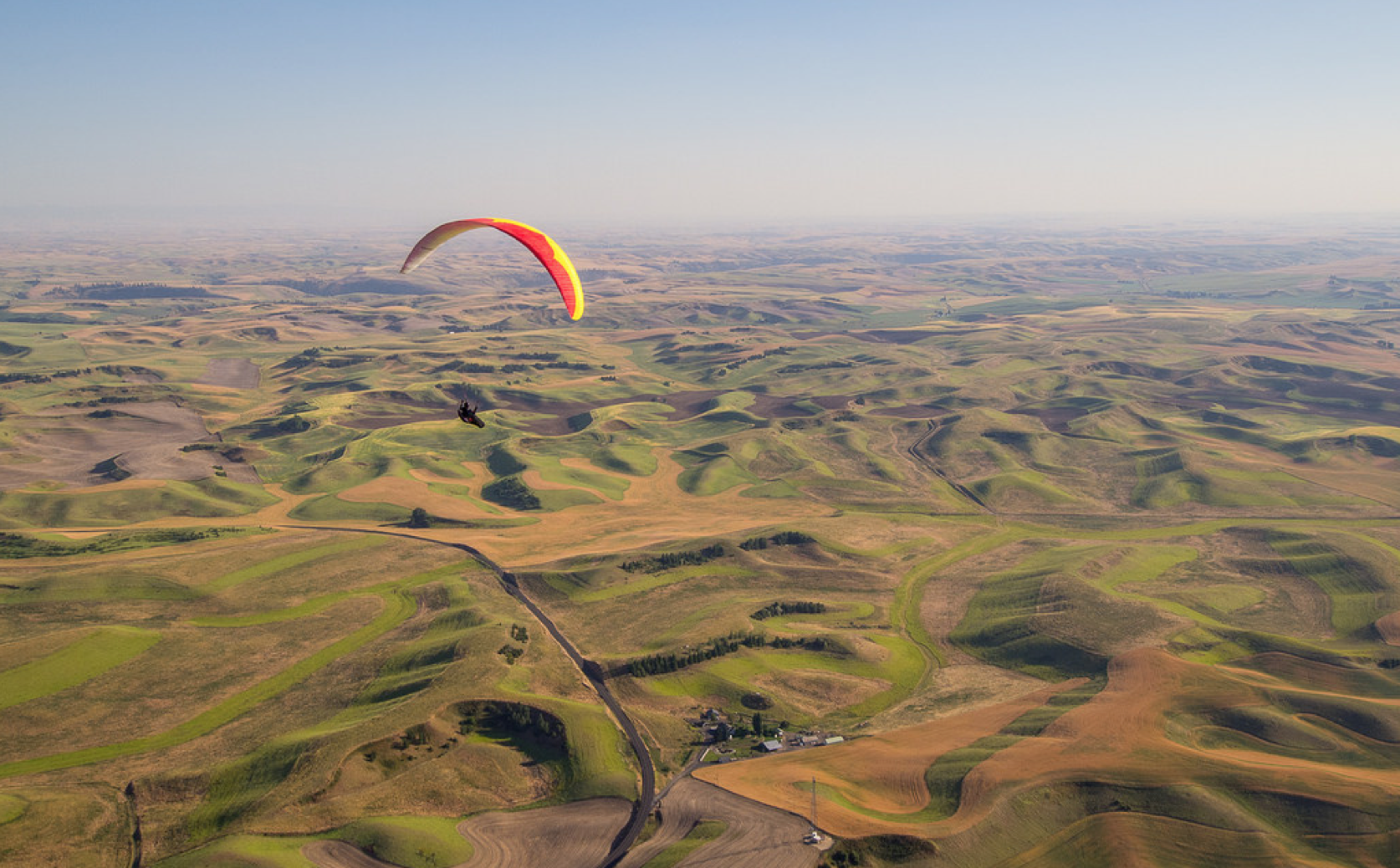
Launching off Mt Mulanje, Africa June 2014

Launching somewhere in Malawi, Africa June 2014.  Photo Jody MacDonald

2015. An absolutely terrifying combination of 4 unique digits. Two reasons. It is a reminder that is bigger than any billboard of how fast time keeps skipping along at an ever faster pace; and it is the year that in just over 6 months time the Red Bull X-Alps will take place. If all goes well between now and then I will be one of 32 international competitors standing at the starting line in Salzburg, heart beating like a snare drum, thrilled and terrified at what is before each of us- quite likely the most grueling adventure race on Earth. My only question now, and my only question at the start will be the same: have I got what it takes?

Doubt isn’t something I’m used to experiencing. And in this case it’s really throwing me off. By nature I’m a confident person, or I guess more accurately- I’m an overly optimistic person. I always think everything will work out because everything always has so I have no reason to believe it won’t. The more implausible the task or dream that I’ve embarked on has always played out rather magnificently. These pursuits haven’t been without their mistakes and bad calls and detours and setbacks, but I’ve learned what has at least for me become a valuable lessen- the riskier the attempt the bigger the payoff. I love competition and I learned from years and years of ski racing that while talent is certainly important, competing at a top level is simply a matter of putting in the time and having a solid head. I’m putting in the time. I’ve got an amazing trainer (Ben Abruzzo) and thus far my Achilles heal- my knees, seem to be handing the abuse just fine. I know from lots of experience that the harder things get, the better I will perform. So why am I so terrified?

Training...

Training…

Most people who know me well have advised me strongly to stay away from the X-Alps. They know I have bad knees and they know that when things get nasty I like everything better.  In an already dangerous sport, this isn’t a good recipe for longevity.  In a race like the X-Alps when things will most certainly be sketchy and we’ll most certainly be exhausted the risks obviously go through the roof. I’ve carved out a pretty fun career in this wacky-ass sport of flying around in the sky without a motor and my friends don’t see the point of risking so much. What if I get hurt?  What if I suck and embarrass myself? What if I destroy what little I have left of my knees? Is it worth it?

The first time I saw the X-Alps was in 2007, barely a year after I learned to fly. I was awestruck. Dumbfounded. It looked like the greatest adventure a person could ever have. Walking and flying as fast as you could across one of the most majestic mountain ranges on Earth? Wow. To do it you had to be an elite pilot and a world-class endurance athlete. I was neither. Every other year for two spellbinding weeks in July I have been glued to my computer screen, watching phenomenally talented and herculean strong men struggle and scrap their way over snow capped peaks and trudging along hot valley floors day after day and it has bewitched me. My long-time flying partner Bruce Marks mentioned during the last race, in 2013 that I should do it. He knows me well. He knows I like suffering and he knows how hungry I am for cross country flying. We’ve been in quite a few crazy situations together back when I was sailing around the world and somehow came out the other side smiling. He was no doubt joking, but I took him seriously. I did the math- I would be 43 years old when it took place. Not exactly a spring chicken. My glory days of ski racing long behind me. But I had decent flying skills, a good head for nasty conditions, and it seemed like a good bit of crazy was necessary, which I have in spades. Questionable knees…but maybe with enough smart training?   Maybe I could do it?

Flying across the Rocky Mountains with Will Gadd.  Photo Pablo Durana

Flying across the Rocky Mountains with Will Gadd. Photo Pablo Durana

This summer during the Rockies expedition with Will Gadd, who competed in the first edition of the Red Bull X-Alps we had a lot of time to talk about the race. In short, he hated it. When the weather is bad you walk from dawn until well after dusk at a torturing pace, the fastest guys covering 100 kilometers in a day. Endless hot tarmac roads, crazy Euro drivers trying to kill you, blistered feet, sore hips, burned lips, black holes for eyeballs. And then you do it the next day, and then the next, and then the next… Of course if the weather is good you fly a good portion of the day, but the pace and professionalism of the race has skyrocketed since those early days so you’re still covering a ton of ground by foot, even on the great flying days.  The teams who excel are clearly incredibly honed machines- organized, practiced, disciplined. Will felt like it just wasn’t a pure way to have an adventure in the mountains. Way too much risk, way too much walking, way too much media, not enough reward.

When I applied to compete in the race this July I didn’t harbor any fantasies that I could win. But I did think I could be competitive. I did very much believe that if I trained like a mad man I could get to the raft in Monaco. Then in September I visited the Coupe Icare festival in France and stood next to Tom De Dorlodot and Paul Gushlbauer, both veterans of the race and my confidence shriveled. Structurally they are built like Chrigel, who has of course dominated the last three events by a WIDE margin. Compared to me they are giants of men, and considerably younger. I started imagining the difference in our strides, by simple mechanics the speed they could maintain given similar fitness levels would be a good percentage faster than I could ever hope to achieve.

Fuel

Fuel

I don’t have many advantages to be honest. I’ve flown a lot in the Alps, but I’ll never have the local knowledge that the Euros do. I’m smaller, older, my joints have taken a lot more pounding, and I haven’t flown nearly as long as most of the guys. My experience bag isn’t nearly as full. The only advantage I might have is that I tend to do OK in rowdy, windy conditions. The gnarlier it gets the more I’m smiling. But like Matt Beechinor, one of my mentors and regular flying partners said recently when we were discussing this very topic- my fears, my doubts: “Gavin the only way you could embarrass yourself is if you pound. If you go over there and risk too much and crash and get hurt, that’s the only way to lose.”  And he’s right. If you approach the Red Bull X-Alps as a competition, to win at any cost, the cost is going to be way too high.  How much am I willing to pay?

Sometime between now and July, amongst the hours and hours and hours of training and miles and sweat and tears that is a question I’ll have to answer. Before that gun goes off I have to have a plan.  One and one only. To have fun, to have the ultimate adventure- and live to tell the tale. Right now that is not the plan. The plan right now is to beat those fuckers!

Screenshot 2014-12-29 16.45.36

USA Team 2 (Bruce Marks and Gavin McClurg) on a recent Hypoxic Training session in Australia. Photo Kari Roberson


Red Bull X-Alps and National Geographic Adventurers of the Year!


This may line up as one of the most exciting weeks of my life.  The world premiere of our film, 500 Miles to Nowhere gets screened at the Banff Mountain Film Festival; Will Gadd and myself have been nominated as the National Geographic Adventurers of the Year for our Rocky Mountain Traverse; and last week the announcement that I’ve been waiting for months to hear finally came out.  I’ve been chosen to compete in this year’s Red Bull X-Alps, lauded as the hardest adventure race on Earth.  1,000 kilometers across the Alps by foot and paraglider, from Salzburg to Monaco.  When I first got into paragliding back in 2006 I heard about the X-Alps and watched that year’s race (2007) hanging from my harness, literally glued to my laptop screen as colored lines attached to mythical pilots moved west across mountains that I’d only dreamt of someday flying.

RBX15_participantLogo-RGB-posA lot has happened since those early days.  Many of those mythical pilots are now my friends.  The alps have almost become a second home.  I keep the Niviuk mobile there year-round, and I’ve flown many of the lines that only a couple years ago seemed impossible.  But the task at hand is honestly terrifying.  I’m not a spring chicken.  I’ve got horrible knees, damaged goods from years of competitive ski racing.  If the weather is bad during the race, as it was this July in the Alps the top guys are pounding out a couple of marathons a day in terms of distance.  No one runs, but they move very fast for 17 hours a day.  Day after day after day.  I can’t run five miles before my knees start talking loudly to me.  By 10 miles they are screaming.


natgeoimages


So a few months ago I brought on a physical trainer, a good friend named Ben Abruzzo, who owns a Cross Fit gym in Albuquerque, is an ex-military bad-ass and trains ultrathon runners and elite athletes.  My ask:  can you get me prepped to pound out 80-100 km a day, day after day without killing my knees carrying my paraglider?  I have always had a weird attraction to pain.  I don’t mind misery, don’t mind suffering.  But I’m not going to ruin two pretty important joints for one race.  Ben said if we do it right, there’s a chance.  The training is going well.  I can’t beat Chrigel in the air.  No one can.  And compared to most of the guys in the race I’m considerably smaller and even though I’ve flown a lot in the Alps, I will never have the local experience that the Euro pilots do.  In short, the odds are not stacked in my favor.

Which suits me just fine.

Watch the teaser video and vote!

Screenshot 2014-11-06 09.31.44