360 Degrees in the Netherlands just published a great feature (if you can read Dutch!) about the Rockies Traverse. Photos by Jody MacDonald
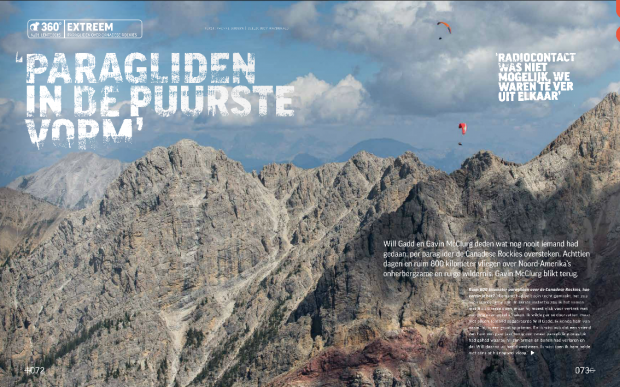
Or read it right here:


360 Degrees in the Netherlands just published a great feature (if you can read Dutch!) about the Rockies Traverse. Photos by Jody MacDonald
Or read it right here:
In this inaugural Cloudbase Mayhem podcast we hear from Bill Belcourt. When we were on the set of 500 Miles to Nowhere with Nate Scales, Matt Beechinor, Nick Greece and myself we had the opportunity to stop by Black Diamond Headquarters and sit down with Bill to discuss among other things throwing a rescue, what it takes to fly big lines, modern glider development, the history of the sport, the concept of “bringing it”, and a whole lot more. This episode is PACKED with incredible information. Whether you are a novice pilot getting a taste for your first XC, or an expert who flies vol biv or world cups, there is a lot to be learned here. Enjoy.

Flying Hurricane Ridge during the 500 Miles Shoot
Like the podcast? A buck an episode, that’s all we ask.
Subscribe to the Cloudbase Mayhem Podcast on Stitcher Radio, Google Play, Tune In, or ITunes!


Podcast: Play in new window | Download (Duration: 37:19 — 42.7MB)
Subscribe: Apple Podcasts | Spotify | Amazon Music | Pandora | Email | TuneIn | Youtube Music | RSS | More

In the 11th hour of a 12 hour training day. Photo Jody MacDonald
The following is taken from a recent interview with Niviuk:
Niviuk pilot Gavin McClurg is having an amazing year. He is one of the 2015 National Geographic Adventurers of the Year for his ground-breaking vol-biv across the Canadian Rockies with the legend mountain athlete Will Gadd, and he’s been selected to compete in this years edition of the hardest adventure race on Earth, the Red Bull X-Alps. We sat down with Gavin recently to find out how his training is going, here’s what he had to say.
Gavin, there’s less than six months until the gun goes off in Salzburg, how is the training going?
Well in some ways I feel like I’ve been training for this race my whole life. It’s kind of everything I’m passionate about all rolled up into one. But when I found out I got accepted in September my stomach did a backflip. I was thrilled but also really nervous. When the weather is bad and we can’t fly covering 60 to 100 kilometers on the ground day after day with a pack is true suffering, and I’m no spring chicken, so I decided to get really serious about physical training. The physical training officially began October 1st, which will give me 9 months of solid prep before the race.

Just lunging around. Photo Jody MacDonald
What does the training look like?
My good friend Ben Abruzzo coordinates all my training. He owns a Cross Fit gym in New Mexico, is a former Army Ranger and just a total bad ass. He does Ultrathons (100 Mile races) for fun and trains high-end endurance athletes who compete in the hardest races in the world. He’s also becoming a great pilot and is really excited about the X-Alps. Because he’s done a lot of this kind of racing himself and has trained so many elite athletes he understands exactly where I need to get and has been very methodically kicking my butt. I wouldn’t be able to do it without him. Each week he puts up my training on Google Docs, we call it “Gavin’s X-Alps Domination!” The first three months were filled with a ton of strength and anaerobic training, mixed with a lot of miles of just walking fast with the pack. Each day is something totally different, which keeps it really fun. Rest and recovery and eating and hydration have been constant themes, and after every work out I spend a lot of time on mobility, making sure the muscles will be ready for the next day. Once the snow started falling we have been doing a TON of vertical training by ski touring here in my local mountains, to emulate the hikes to launch. I’ve gone up my local hill so many times I have memorized every single foot of that grade!

9 stations, 2 sets of ten at each station, 80 seconds to complete each station, go as heavy as possible = torture
Since January 1st the training has switched more to heavy weight strength training using intervals and a lot of aerobic training, keeping the heart rate at 70% of max for very long periods. When the weather is good enough I do it outside, when it’s bad I literally live at the gym. We had our first “test” day this week to emulate a day of the race. It was 12 straight hours with very fast transitions between the different work outs, with a lot of focus on keeping fueled and hydrated and keeping the feet happy- at 0600 a 10 km walk with my X-Alps pack, then a brutal Cross Fit type Leg crusher at the gym, then 2 hours of vertical training on the Elliptical with the heart rate above 150 with the pack, then 5 hours of alpine skiing at the local ski resort, then a 15 km walk back home, again with the pack. It went incredibly well, I was buzzing all day and felt great. It was a huge confidence boost, to see how well the training is paying off and literally watching my body morph into a machine capable of taking a lot of punishment.”

Footwear is a big piece of the puzzle, we have to change shoes every 2-3 hours during the race. Salomon has been very kind to me, my footwear of choice after testing more than 10 manufacturers of running shoes.
It almost sounds like you’re having fun?
I am! For quite a long time I was doing the training and loving it, but I was still dreading the race, and really questioning if my knees would be able to handle the pounding (I have bad knees from years of competitive ski racing). But now I’m feeling really confident. I have had no pain at all and my body seems to be responding really well to the training. I can’t wait to wake up each day, take a look at the domination schedule and go hard. Figuring out how to stay fueled and recover fast is a science, and it’s been really fun to figure out. I eat constantly and even with all the training have managed to gain a few pounds. With a combination of SFH protein shakes jacked up with kale, yoghurt, berries, sunflower butter and other goodies, a huge dose of Pocketfuel almond butters while I’m moving at regular intervals, and pure electrolytes added to my water I am able to charge hard for extended periods. It’s an incredible opportunity- to have very little to focus on outside of getting strong. There is still a long ways to go, but I’ll be ready.

Row row row. And then row some more.
Tell us about your gear selection for the race?
Well like everyone else in the race, I’m trying to shave ounces wherever I can. I’ve been making lists and refining my equipment for months. You can’t believe what goes into an endeavor like this. Helmet, radio, vario, maps, clothing, underwear, socks, shoes (I am currently breaking in 10 pairs of shoes!)- the list just goes on and on. I’ve decided on the Niviuk Peak 3 X-Alps (lightweight version) for my wing, and the SupAir XA-13 for my harness for training, which will be replaced by an even lighter SupAir harness before the race. The wing choice was something I lamented over for quite awhile. I’ve flown more on the Peak 3 than any other wing so this was the obvious choice. It’s incredibly forgiving, solid in rough conditions and I know it well. It was the wing I used for the Rockies Traverse and the wing I used to break the North American foot launch record (387 km) in really, really rowdy air here at my home site of Sun Valley. So for the X-Alps, when we will often have to fly in terrible conditions this will be a perfect wing. I think having a wing that you can land in tight places, be able to launch in sketchy conditions when you’re exhausted, and trust in strong wind and lee conditions is more important than having a glider with a better glide like the Icepeak 7. But knowing that Chrigel and some of the other athletes will be using wings with a higher aspect ratio makes me question this decision. I considered having Niviuk build me a light version of the IP 7, but after consulting a bunch of veterans of the race, they convinced me that the Peak 3 was definitely the choice.

Well Gavin, we wish you the best and we’ll let you get back to your training!
Thank you, and see you all in July!

Gavin on glide towards Mt Robson during the Rockies Traverse this August

Launching somewhere in Malawi, Africa June 2014. Photo Jody MacDonald
2015. An absolutely terrifying combination of 4 unique digits. Two reasons. It is a reminder that is bigger than any billboard of how fast time keeps skipping along at an ever faster pace; and it is the year that in just over 6 months time the Red Bull X-Alps will take place. If all goes well between now and then I will be one of 32 international competitors standing at the starting line in Salzburg, heart beating like a snare drum, thrilled and terrified at what is before each of us- quite likely the most grueling adventure race on Earth. My only question now, and my only question at the start will be the same: have I got what it takes?
Doubt isn’t something I’m used to experiencing. And in this case it’s really throwing me off. By nature I’m a confident person, or I guess more accurately- I’m an overly optimistic person. I always think everything will work out because everything always has so I have no reason to believe it won’t. The more implausible the task or dream that I’ve embarked on has always played out rather magnificently. These pursuits haven’t been without their mistakes and bad calls and detours and setbacks, but I’ve learned what has at least for me become a valuable lessen- the riskier the attempt the bigger the payoff. I love competition and I learned from years and years of ski racing that while talent is certainly important, competing at a top level is simply a matter of putting in the time and having a solid head. I’m putting in the time. I’ve got an amazing trainer (Ben Abruzzo) and thus far my Achilles heal- my knees, seem to be handing the abuse just fine. I know from lots of experience that the harder things get, the better I will perform. So why am I so terrified?

Training…
Most people who know me well have advised me strongly to stay away from the X-Alps. They know I have bad knees and they know that when things get nasty I like everything better. In an already dangerous sport, this isn’t a good recipe for longevity. In a race like the X-Alps when things will most certainly be sketchy and we’ll most certainly be exhausted the risks obviously go through the roof. I’ve carved out a pretty fun career in this wacky-ass sport of flying around in the sky without a motor and my friends don’t see the point of risking so much. What if I get hurt? What if I suck and embarrass myself? What if I destroy what little I have left of my knees? Is it worth it?
The first time I saw the X-Alps was in 2007, barely a year after I learned to fly. I was awestruck. Dumbfounded. It looked like the greatest adventure a person could ever have. Walking and flying as fast as you could across one of the most majestic mountain ranges on Earth? Wow. To do it you had to be an elite pilot and a world-class endurance athlete. I was neither. Every other year for two spellbinding weeks in July I have been glued to my computer screen, watching phenomenally talented and herculean strong men struggle and scrap their way over snow capped peaks and trudging along hot valley floors day after day and it has bewitched me. My long-time flying partner Bruce Marks mentioned during the last race, in 2013 that I should do it. He knows me well. He knows I like suffering and he knows how hungry I am for cross country flying. We’ve been in quite a few crazy situations together back when I was sailing around the world and somehow came out the other side smiling. He was no doubt joking, but I took him seriously. I did the math- I would be 43 years old when it took place. Not exactly a spring chicken. My glory days of ski racing long behind me. But I had decent flying skills, a good head for nasty conditions, and it seemed like a good bit of crazy was necessary, which I have in spades. Questionable knees…but maybe with enough smart training? Maybe I could do it?

Flying across the Rocky Mountains with Will Gadd. Photo Pablo Durana
This summer during the Rockies expedition with Will Gadd, who competed in the first edition of the Red Bull X-Alps we had a lot of time to talk about the race. In short, he hated it. When the weather is bad you walk from dawn until well after dusk at a torturing pace, the fastest guys covering 100 kilometers in a day. Endless hot tarmac roads, crazy Euro drivers trying to kill you, blistered feet, sore hips, burned lips, black holes for eyeballs. And then you do it the next day, and then the next, and then the next… Of course if the weather is good you fly a good portion of the day, but the pace and professionalism of the race has skyrocketed since those early days so you’re still covering a ton of ground by foot, even on the great flying days. The teams who excel are clearly incredibly honed machines- organized, practiced, disciplined. Will felt like it just wasn’t a pure way to have an adventure in the mountains. Way too much risk, way too much walking, way too much media, not enough reward.
When I applied to compete in the race this July I didn’t harbor any fantasies that I could win. But I did think I could be competitive. I did very much believe that if I trained like a mad man I could get to the raft in Monaco. Then in September I visited the Coupe Icare festival in France and stood next to Tom De Dorlodot and Paul Gushlbauer, both veterans of the race and my confidence shriveled. Structurally they are built like Chrigel, who has of course dominated the last three events by a WIDE margin. Compared to me they are giants of men, and considerably younger. I started imagining the difference in our strides, by simple mechanics the speed they could maintain given similar fitness levels would be a good percentage faster than I could ever hope to achieve.

Fuel
I don’t have many advantages to be honest. I’ve flown a lot in the Alps, but I’ll never have the local knowledge that the Euros do. I’m smaller, older, my joints have taken a lot more pounding, and I haven’t flown nearly as long as most of the guys. My experience bag isn’t nearly as full. The only advantage I might have is that I tend to do OK in rowdy, windy conditions. The gnarlier it gets the more I’m smiling. But like Matt Beechinor, one of my mentors and regular flying partners said recently when we were discussing this very topic- my fears, my doubts: “Gavin the only way you could embarrass yourself is if you pound. If you go over there and risk too much and crash and get hurt, that’s the only way to lose.” And he’s right. If you approach the Red Bull X-Alps as a competition, to win at any cost, the cost is going to be way too high. How much am I willing to pay?
Sometime between now and July, amongst the hours and hours and hours of training and miles and sweat and tears that is a question I’ll have to answer. Before that gun goes off I have to have a plan. One and one only. To have fun, to have the ultimate adventure- and live to tell the tale. Right now that is not the plan. The plan right now is to beat those fuckers!

USA Team 2 (Bruce Marks and Gavin McClurg) on a recent Hypoxic Training session in Australia. Photo Kari Roberson
This may line up as one of the most exciting weeks of my life. The world premiere of our film, 500 Miles to Nowhere gets screened at the Banff Mountain Film Festival; Will Gadd and myself have been nominated as the National Geographic Adventurers of the Year for our Rocky Mountain Traverse; and last week the announcement that I’ve been waiting for months to hear finally came out. I’ve been chosen to compete in this year’s Red Bull X-Alps, lauded as the hardest adventure race on Earth. 1,000 kilometers across the Alps by foot and paraglider, from Salzburg to Monaco. When I first got into paragliding back in 2006 I heard about the X-Alps and watched that year’s race (2007) hanging from my harness, literally glued to my laptop screen as colored lines attached to mythical pilots moved west across mountains that I’d only dreamt of someday flying.
 A lot has happened since those early days. Many of those mythical pilots are now my friends. The alps have almost become a second home. I keep the Niviuk mobile there year-round, and I’ve flown many of the lines that only a couple years ago seemed impossible. But the task at hand is honestly terrifying. I’m not a spring chicken. I’ve got horrible knees, damaged goods from years of competitive ski racing. If the weather is bad during the race, as it was this July in the Alps the top guys are pounding out a couple of marathons a day in terms of distance. No one runs, but they move very fast for 17 hours a day. Day after day after day. I can’t run five miles before my knees start talking loudly to me. By 10 miles they are screaming.

So a few months ago I brought on a physical trainer, a good friend named Ben Abruzzo, who owns a Cross Fit gym in Albuquerque, is an ex-military bad-ass and trains ultrathon runners and elite athletes. My ask: can you get me prepped to pound out 80-100 km a day, day after day without killing my knees carrying my paraglider? I have always had a weird attraction to pain. I don’t mind misery, don’t mind suffering. But I’m not going to ruin two pretty important joints for one race. Ben said if we do it right, there’s a chance. The training is going well. I can’t beat Chrigel in the air. No one can. And compared to most of the guys in the race I’m considerably smaller and even though I’ve flown a lot in the Alps, I will never have the local experience that the Euro pilots do. In short, the odds are not stacked in my favor.
Which suits me just fine.
Watch the teaser video and vote!
We just got some INSANE news- our passion project from last year “500 Miles to Nowhere” has just been chosen a Finalist at this year’s Banff Mountain Film Festival. The Banff Film Festival is the crowning achievement of any adventure film, and is by far and away the biggest and most prestigious adventure and mountain film festival in the world. Each year, the films travel to 40 countries reaching more than 390,000 people at over 840 screenings. So the Cloudbase Collective will be heading to Banff this November and we hope you’ll join us either in Banff, or catch the film as it travels the world!
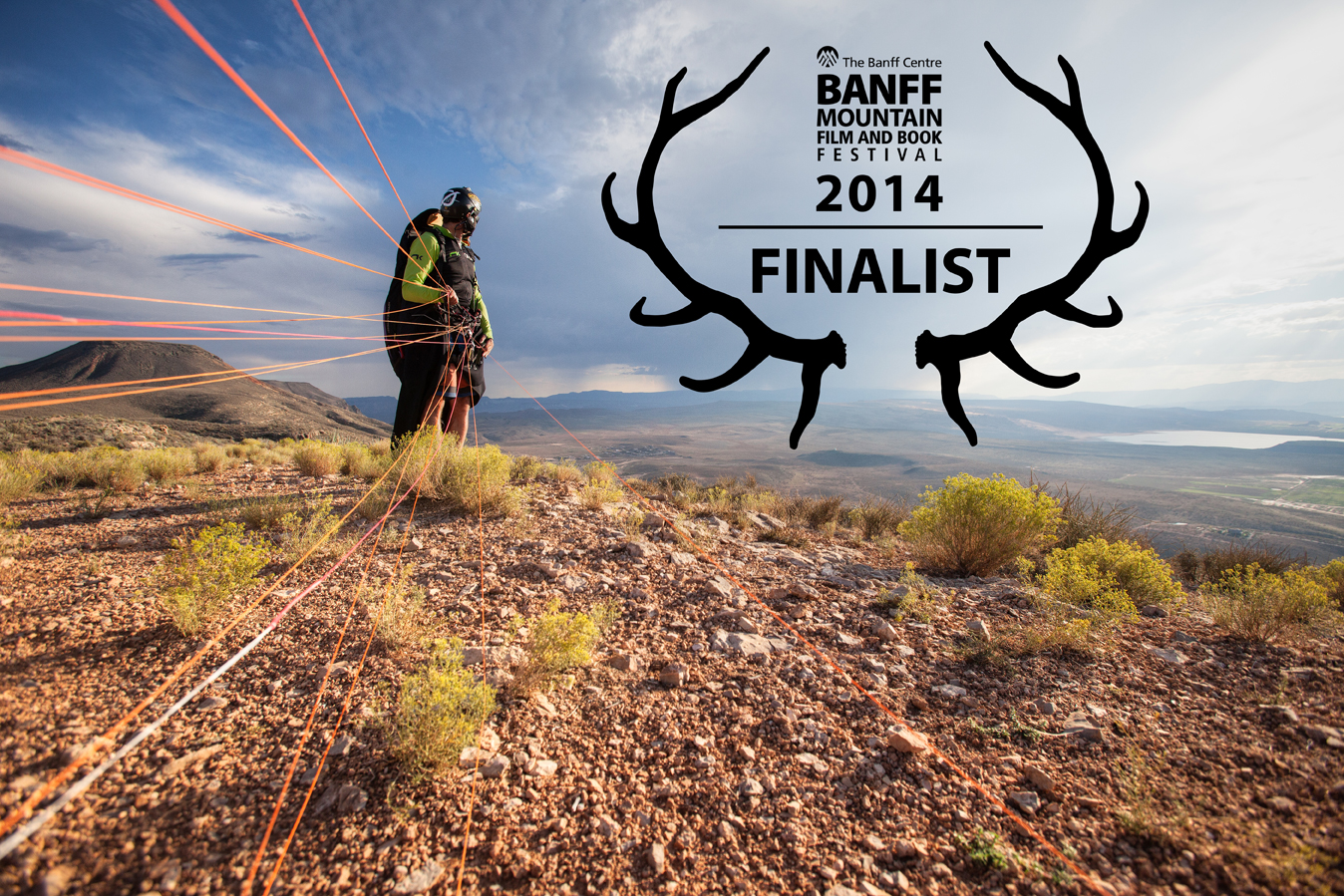
Gavin prepping for launch, on the set of 500 Miles to Nowhere

Perfect spot for a high alpine top land and camp- Photo Pablo Durana
Will Gadd and I just completed what we believe to be the longest connected track log that has ever been flown. About 650 kilometers across the Canadian Rockies to the US border. One rule: all forward progress was made in the air. Most of the line had never been flown. All up it took us 35 days to complete, with two long bouts of bad weather that shut us down completely for more than a week at a time. A great deal of media will be out shortly documenting the journey, that is not what this essay is all about. I’m still too frazzled, thrilled, shocked, and exhausted to put into words what the expedition meant. I haven’t even begun to look back and process the risks, the rewards, and ultimately what comes down to a lesson in humility. We pressed awfully hard to make it happen, often in desperate terrain and desperate conditions. You can’t get away with that too many times without serious consequences. But we made it whole, safely, in one piece and one thing I have had a moment to reflect on is how much we relied on our gear. What worked, what didn’t, what we’d do differently. Will is also going to write up an essay on gear as well as the ethics of “vol biv”, which I look forward to reading very much, as I learned on this trip that we didn’t always agree, but he was always right, and he has been an incredible mentor- his knowledge, skill and approach are incredibly valuable to the human flight community.
If you don’t fly vol-biv, this article may not make most exciting reading. But if you play in the mountains; on paragliders; on foot or on steep walls; or any other form of alpine travel this may be of use. I spent nearly 3 weeks packing for this trip, laying everything out again and again looking for places I could cut an ounce here or there, making sure I had everything I needed to be self-sufficient. Finding the right balance of things needed vs comfort vs weight when everything needs to ride on your back on the ground and in the air is challenging.

Light(ish) and fast was the goal when we weren’t in the air- Photo Jody MacDonald
For transparency, anything marked with an * was provided by my sponsors.
My pack weighed exactly 60 pounds at the start. Will’s was a couple pounds lighter, owing to using the Ozium lightweight harness (more on this choice below). I cut nothing during the trip, in fact I added a touch with a better sleeping bag as it got pretty cold at the end. This was with 4 days of food (details below), all gear, and no water. Luckily there was water or snow everywhere on the expedition, so we never had to carry more than 3 litres. We top landed nearly the whole trip and were able in almost every case to take off from the same place the next day (or the next flyable day), and because of our rule of no forward progress unless we were in the air (we could go down, up, or back to reprovision or find a launch), we didn’t have to cover much ground on foot. Straight line distance from our first launch above the town of McBride to the US border is 620 kilometers. Our flight logs added up to 802 kilometers as we made a detour the first day to fly right over Mt Robson (EPIC!) and had a number of flights where we had to travel north or south to link the track log, or for a number of reasons couldn’t fly the crow line.
Day 1, Heading toward Mt Robson, which we would SESSION!
ELECTRONICS:

Charging instruments with the NocoXgrid- Photo Pablo Durana
GEAR:

Top land, camp, take off the next day. It doesn’t get much better than this Photo Pablo Durana

Laden- Photo Pablo Durana
CLOTHING
BATHROOM KIT
KITCHEN/FOOD
Going BIG. Photo Pablo Durana
SPARES
Down in the truck Will and I both had a couple big bins of extras. Spare wings (there are a LOT of trees on this route!), harness, reserve, batteries, back up radios, varios, chargers, trekking poles, hand warmers, condom catheters, wing repair kits, sunblock, clothing, and food. We each packed 4 days worth of food in numbered Zip Lock bags so we could just grab and go, and not have to deal with packing or forgetting something en-route.
It was the most radical journey either of us have ever done. We made a great team, I think we did it in style and we definitely gave it everything we had. Huge, huge heartfelt thanks to ReelWaterProductions and Red Bull Media House for believing in us and for giving us the opportunity to fly this insane line, and not completely losing it when it took 35 days instead of 2 weeks!

Launching over Kinebasket Lake, Monashees- Photo Pablo Durana

Big country, a lot of ice
The folks at Red Bull Media House/ Red Bull Adventure just put together a super fun edit of our Alaska exploits this spring and back in 2012, during our recons to see if my dream of flying the Alaska Range is feasible. Sit back, RELAX, and enjoy Alaska from the air….
Many months ago Nick Greece contacted me about something that has increased my blood pressure since the words left his mouth. Flying across the Canadian Rockies. Yoyo. Banff. Jasper. Bugaboos. Hulking glaciers; massive steep mountains; vasts swaths of DEEPness; grizzlies; mosquitos the size of hummingbirds; going farther in the air than anyone ever has. He’d been contacted by ReelWaterProductions, who specialize in filming impossible missions in impossible places. They had a budget, they just needed a “protagonist”, and preferably two. And to sell it to the client, it needed to be a record. Farther, deeper, never been done…

The Deepness
Vol Bivouac (fly camp) style adventures seem to be all the recent rage in this rather off-route, deeply addicting fringe sport that a friend recently pointed out quite eloquently as “ridiculous”. Flying plastic and strings hundreds of miles without an engine, everything needed to survive on your back. People keep going farther and farther. The French team of Thomas Punty and Nelson Defreyman have flown, hiked, bicycled, and hitch-hiked an absurd distance this year from Alberta to somewhere in New Mexico. Dave Turner soloed 1300 km from Nice to Slovenia across the Alps. Stefan Bocks cruised 1,000 km across Central Asia. Our own team flew close to 800 km across the Sierras to the Oregon border. Some of that same team hiked and flew well over 1,000 km across India and Nepal. Luc Armont set the stage years ago doing a similar length solo in the Himalayas. Tom DeDorlodot and Paul Gushlbauer were attempting an 1800 km hike and fly route in Europe and were over 1,000 km’s in but were stopped when Tom had an unfortunate crash just days ago. But to my knowledge all of these trips have one thing in common: to a large extent they are backpacking trips. When the weather is bad and we can’t fly, we hike. The ultimate example of this style of travel is the Red Bull X-Alps. A suffer fest like no other. Racing across huge mountains on foot and in the air.

Gonna be flying some big ass mountains!
So, in order to break the “record”, all one really has to be willing to do is hike farther than anyone else, and at some point fly. There aren’t really any “rules” that our tiny community of adventure pilots is following. What is allowed, what isn’t? I was pondering this very question, asking myself what I would be willing to do for this film when Will Gadd quickly solved the dilemma. Leave it to a former national champion, former distance record holder, world record ice-climber, and hands-down one of if not the best mountain athlete in modern times to quickly come up with a solution. What he calls “the truest and purest paragliding adventure that has ever been done.” This Friday Will and I will approach vol-biv paragliding across the Canadian Rockies in a whole new style. Only one rule: any forward progress must be on the glider, to create a continuous flight log. We can hike back, we can hike up and down, in fact we will need to- A LOT, in order to reprovision (we can only carry 3 days of food), but to move forward, we have to be flying. If we are successful, to our knowledge it will be the longest linked paragliding trip that has ever been done. We have 3 weeks to accomplish the goal, the US border.

The GoPro kit
We have our protagonists. Two guys who have never met. One was competing in the X-Alps before the other had even had his first flight. One had broken the North American Distance record before the other even knew paragliders could be used to travel. Two guys who have lived through some pretty epic adventures by air, water and dirt using skis, kayaks, sails, ropes and wings are about to set off on what be our wildest expedition yet. I’ve been studying the route for months, and that adrenaline kick I got after Nick’s call has if anything only increased. My crack is flying deep lines, but this one is a whole new kind of DEEP. Landing options in many cases don’t exist. Very few roads, more bears than people, rivers with no bridges, and a LOT of area that no one has ever flown. Excited? Yes. Nervous? Yes. A little scared? You bet.

Let’s get some!
For the past two weeks my living room has been an explosion of gear. Lists, checks, lists, checks, calls to sponsors for more stuff, trimming, lists, repacking, lists, repeat. Due to the remoteness, inevitable bad weather, bugs, bears and fire risk we’re both taking a lot more kit than I’d like to, or ever have before. But I think I’ve finally got it down. If I’ve missed something, my back will thank me.
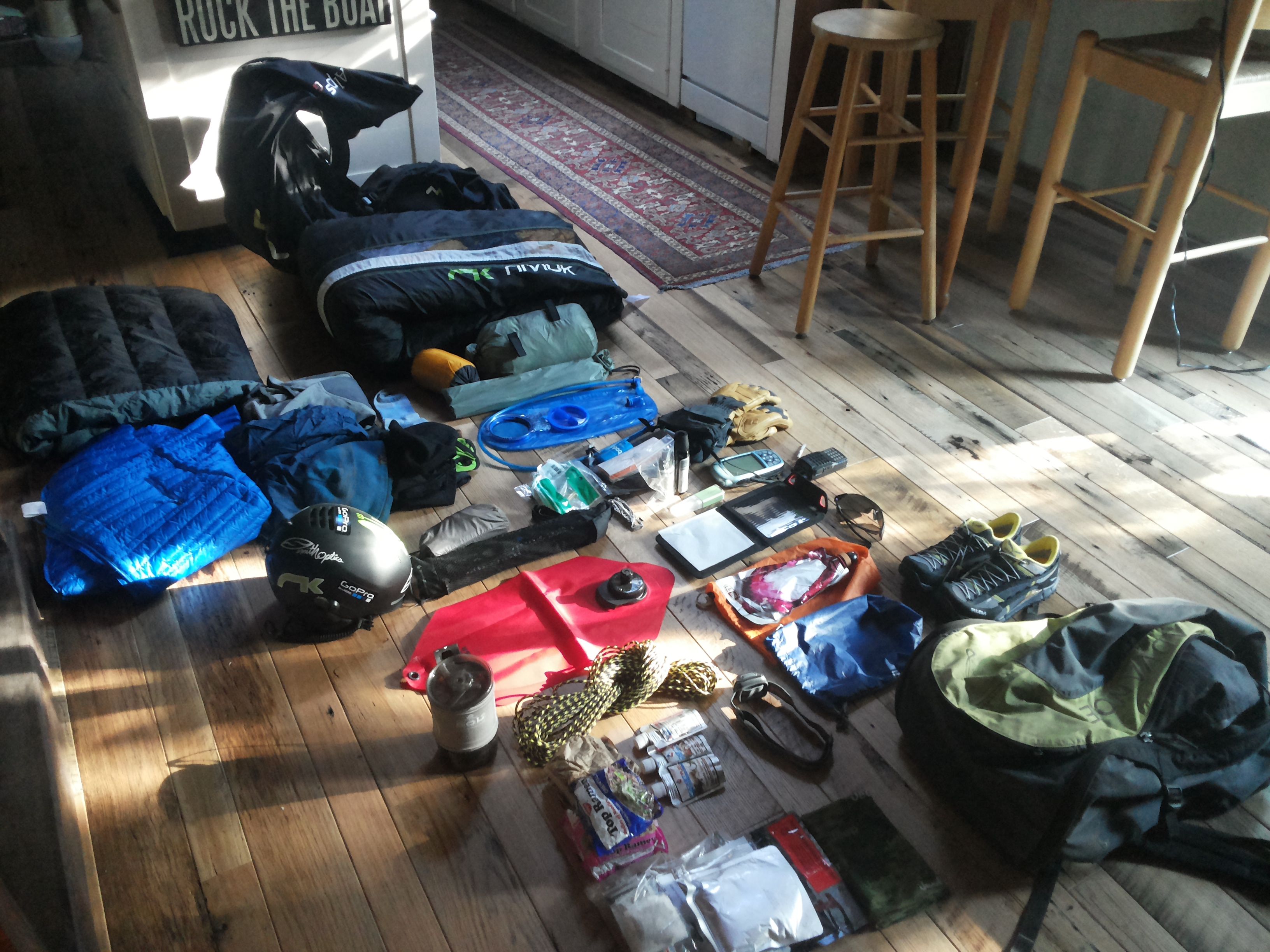
Checking the lists
In this photo:
All up: Dry weight (no water) exactly 50 pounds. With water (10 liters), 72 pounds.
It all starts August 1st. We’ve got three weeks to make the border. But we can only get there by flying. I imagine the adrenaline I’ve been feeling for weeks is about to get a wee bit more intense.