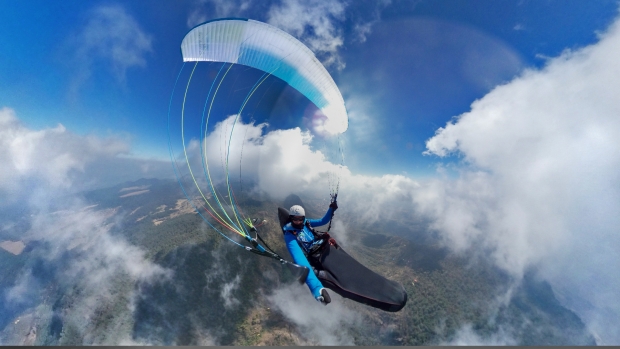
Adel crushing in Colombia- Photo Trey Hackney
What makes a successful pilot? Is it just talent and hours or something anyone can learn with training and application? Sports psychology gives us the answer if we break it down into three dimensions: technical, physical and mental. In this episode Adél Honti explains how her analytical approach and study of human psychology has helped her understand how to operate more adeptly in our invisible world. Adél explains why “races are won and lost in the mind.” How do we get into the “Flow”? How should we approach training? How should we deal with failure? How can we learn to focus for longer periods? How can we radically accelerate our own learning and ability? How can we pay more attention to the technical aspects of the sport to improve our speed? Why fear is so important in not only keeping us safe but making flying enjoyable, and how we can learn to deal with it in a healthy way. How physical training is so critical to flying long XC flights and for maintaining stamina in competitions. We all agree that confidence and the mental side of flying is critical to flying well and staying safe, but if we aren’t naturally confident people how can we build this skill? Adél describes how to set achievable goals and how to identify weaknesses and mistakes (not just in flying, but in your life) in order to tackle them head-on which leads to flying farther and faster and may make some surprisingly positive changes in your life as well. And finally Adél presents some theories that I hadn’t heard before regarding the lack of women in the sport.
This honest frank talk is packed with the most actionable advice of any of the talks we’ve yet had on the Mayhem. This one is urgent and powerful and absolutely packed with incredible advice- ENJOY and please please share! And don’t skip the Show Notes- there’s a LOT there.
More information about Adél:
“I am a cross country guide and instructor and tandem pilot: I teach in a tandem how to fly fast and long xc, but I don’t do commercial flights and I don’t teach beginners. Teaching is a hobby, a way to give back to my local community as my best friend and club owner taught me all the basics and more, so this is the least I can do.
I started flying in 2004, made my instructor license in 2013, the same year I entered my very first comp as well. Currently I have about 800 flight hours.
I have been sportwoman of the year in xc pg for 3 years in a row. My current world ranking is 172 overall, 8th woman.
Last year at the world championship I was 6th in the female ranking.
I am:
-a sport diplomat in the CIVL and member of the Hungarian paragliding committee of our National Aeroclub member of the national team, 4th in our overall ranking
-admin of the biggest female paragliding and hanggliding community, close to 1000 members on facebook.
-the first Hungarian female pilot ever flying the Worlds or Europeans or ever making it to the national overall podium
I have rewritten our sport codex and harmonized it with the FAI rules plus created a female national team
I organized the last 2 national championships
In my civil life i am an entrepreneur and business developer. I have built so far 3 businesses and sold successfully the first. I have a degree in Law, but I also did 4 years of international relations in the faculty of Economics (no degree there, I skipped as my first business kept me super busy). When I started flying I gave up the international tax law career and switched to entrepreneurship to be my own slaveowner:)”
A buck an episode, that’s all we ask.
Show Notes:
First if you’re looking for the “Pilot needs ride to car” sign I mention in the episode go here.
- What makes a successful pilot: physically, technically and mentally?
Sport psychology has the answer:
Break down your sport to 3 dimensions:
Physical
Why do we need to be fit for paragliding? Isn’t it a technical sport?
- for endurance and ability to concentrate long: records, big comps are often 2 weeks long
- for safety
- ability to stall the glider even after a 5 hour long flight and B riser control – not to have tired shoulder muscles
- being able to land with a 30 km heavy equipment in turbulent conditions require strong ligaments – a lot of balancing exercises are there for it
- pilots often land near the road so they do not have to carry their equipment
- more precise glider control – I often feel like sitting on a fitball and balancing all the time in strong conditions. The more aggression I feel from my equipment, I react with the same level of input sometimes moving all the time with my whole upper body from my hips
I work out 3-4 times a week: 1 hour building muscles, 30 minutes cardio (running)
I love food and I have a sweet tooth, so without this I would probably be able to fly an XL size glider very fast J I already have way more built in ballast then necessary J
Also my personal preference is to sit in the middle of my weight range and be able to ballast up or dump the ballast if the weather turns super weak, so for optimal performance I have to keep my body weight at a certain number
Technical
- get to know your instruments and understand maximum capacity
- get to know the capacity of the glider at SIV training – after a certain point in development Acro is mandatory
- learn to take off with even 33 kg equipment even in gentle back wind
- learn a lot of meteorology – understand the sky not just now but predict what will happen in some hours on a comp course route
- learn to deploy your reserve parachute in the gym, practice landing with a parachute by jumping off a high table to a gym mat with your harness on and roll off the energy
- g force trainer will teach you to understand the G force in a spiral dive – I started to loose consciousness at 7G
Psychological elements
As I said I believe this is 80% of the success. For me it is certainly true. There are many pilots out there, who are more athletic, or have better glider control. The key of my performance is my ability to enjoy what I do, as it is just a game, and the fact that I am not afraid of the maze of my psyche. To admit my weaknesses is not a weakness but a strength.
Goal is to get in the Flow
(theory from Mihaly Csikszentmihalyi Hungarian psychologist). NOTE: one of our listeners, Paul Boneo wrote up a really great summary of flow, check it out here: https://hastyreader.com/flow-psychology-mihaly-csikszentmihalyi/
Y axis: the level of challenge
X axis : level of skill /experience

Confucius: The tiger has to be killed in our mind first, the rest is just formality.
My methods:
- Modelling: if i have to fly for 10 hours, but i am not sure i can do it, i should sit in a car and drive 10 hours without stopping
if i am afraid of freefall, i can learn skydiving etc
– Visualization: imagining the task before taking off, imagining during flight how the thermal we are in looks like (is it a raindrop or a fried egg) i imagine the air a s a river flowing over objects to understand the movement of it
– Using a mantra :
hohoho ho, the sea is rough today,
I have done it before, I am a kickass pilot
Huh I am in bad company, this coffee is already brewed, lets just speed up or slow down
- learning to deal with fear:
lets go back to the flow theory chart:
Fear is always present when one is outside of one’s comfort zone, it is important to understand that it is NOT something that will ever go away.
I often feel that pilots treat it as a macho thing and would never admit being scared at certain situations.
Very few people can actually lose the feeling of fear all-together, but that is a ticket to a body bag. It has the same dangers as a person whose skin looses all feelings and cannot tell when he is freezing or burning.
Jeb Corlis, a top wingsuit pilot said after his near fatal crash that: “I made a big mistake, I lost fear. Fear is a super important thing, man. Without fear… you will die.”
https://www.youtube.com/watch?v=1hKhofOF_zo
THE KEY IS NOT TO TRY TO LOSE FEAR BUT TO LEARN TO DEAL WITH IT.
I use many tips from Seven Steps to Dealing with Fear in Paragliding written by Heike Hamann
http://7steps2dealingwithfear.com/
I imagine myself from one of the best photos where I look cool
mini goal setting: I allow myself to land after 10 more minutes of flight
other things I do to deal with my fears:
Siv training, mental training, listening to deep house
set not result type of goals but performance goals
eg: not that I want to be 1st in this comp, but take apart the requirements what is needed to get in goal fast: eg get the start right, how to choose the best and strongest climbs, be the best climber in a thermal, optimize the equipment well, chose the best lines to glide, learn to rule the gaggle, when is it the right time to start the final glide on full speed
work on one goal only at a time and learn to perfect that one element before you move on to the next – write down in a bullet point diary what you do well and what mistakes you have done during a task, and you will see a pattern – mistakes you often repeat.
there is always a next task, a next comp, every single comp is just a training for the next one. Comp flying is not a destination, it is a constant journey of learning and getting better. As long as I can learn to do things I never believed myself capable, I am proud and happy.
- self confidence: essential for success
it does not matter who is under the helmet, even if you fly with the world champion, do not get intimidated, you have full rights to be in the air just as anybody else. Do not let the better pilots cut in in front of you at take off or in a thermal, don’t let yourself be bullied
- meditation: 15 minutes worth with a couple hours of sleep helps to focus
– focusing: learn to concentrate long on many things at the same time (instruments, weather, other pilots around you, birds, clouds, dust etc)
from the same level pilots the person who can concentrate longest to most changing factors during a task will probably be the winner
exercise: Fit4Race type of training for racecar drivers where one has to do several times at the same time eg kneel on a fitball and throw with each hand a different size of small ball to a wall and catch it. It feels like training for the circus, but it is highly effective J
By mental training performance can be raised by 40%
according to a study where the brain functions of expert formula 1 drivers and the general public were compared in a high speed high focus driving exercise.
https://www.youtube.com/watch?v=fG4DO22bWLo
the right mentor is not necessarily the best pilot, but a pilot with the ability to analyze one’s patterns and offer progression advice
- objective self analysis: ego has no place here, one needs to be brutally honest with oneself to understand that sometimes even a mentally healthy person can suffer from forgotten trauma, blocks or fear of failure
Final thought: we fly exactly as we feel. Races can be won or lost in the mind.
- Do we need a female category in comps? Why are there so few women in freeflight? What are the psychological, technical and physical challenges of a healthy female athlete in this sport?
It is a difficult question to answer and since I have been flying comps I went around a full circle. First I was all for it, then in the rush for gender equality I though it is not necessary anymore, we should have weight classes, then I arrived back to the beginning, saying yes, we do need it, at least as long as certain criteria aren’t met.
Lets start with the obvious:
What is an average female pilot profile? (based on a survey with 290 pilots I made)
30-40 year olds, fly EN B wings, 80% of them has a take off weight of 60-95 kgs, 70 % of them live in Europe, 23 % lives in the US or Canada.
When asked the question if they ever experienced any disadvantages of being female in paragliding, 37% replied with a yes.
We have less time to build a career than men:
To get to overall podium on a smaller cat2 one needs to compete in average for 5 years 4-5 comps a year. Most people start paragliding in their late 20s early 30s, then after a couple of years of cross coutry they start to compete. By this time women are at home with kids, and have zero time for the sport not to mention comp flying.
If you check the average age of a PWC, then you will not be surprised to see many people over the age or 40 or around the age of 50 there. To be that good one needs experience that builds up in decades and not mere years. A woman who wishes to have 2 kids does not have 10 years in paragliding to build a career before she retires to start a family.

Are there any technical disadvantages for women?
Absolutely no. We can thermal, take off, land, push the bar, read the weather or our instruments just as good as any man can do.
Psychological:
- Women have a different risk taking profile from men in general, especially after childbirth. Not many women are interested in adventure sports to start with
- Societal pressure to fit in with a gender role: adventure sports are considered sexy if men do it, but the exact opposite for women: reckless, too masculine, these women are not feminine. In many countries racing paragliders as a woman while one has kids are seriously frown upon, and the family puts pressure on a woman to stop.
– Being part of a minority is challenging: bullying, sexism, being weaker
women don’t win comps in overall, so women often do not have enough confidence to see themselves on an overall podium
There is no male podium. Why? Many comp organizers I asked said that they never considered making a male podium as it is pointless, only men win overalls, and why should they give 2 trophies for the same 3 guys for being the best man and best overall? It is a waste of money. As a comp organizer myself I get that. As a woman I feel it is very discouraging to women, it sends the wrong message: that we won’t ever make overall podiums. What if we do? I have stood on the overall podium twice already, and it was unfair to my fellow male pilots not to be on male podium.
The odds are against us. The female and male brain is working differently, but there is absolutely no evidence that women have a different IQ from men. Why are there less female top pilots then men?
The answer is easy: there are 130.000 pilots wordwhide from which only 10 % are female. If we say that most pilots are average in skills, but there are a few exceptionally good ones, lets say 1 from 10 thousand is a genius with the exact same ability as any other genius, then statistically speaking we end up having 11 genius male pilots fighting wor world champion status and 1 genius female pilot….is is simply 10 times more likely that that woman won’t make it to overall podium, based on stats only.
| total no. of pilots |
130000 |
geniuses |
| men |
117000 |
11,7 |
| women |
13000 |
1,3 |
- Gender equality differs from country to country. Pilots are often very independent people, able to afford the equipment and travel alone. Women in many countries still do not enjoy the same salaries as men do and simply cannot afford as much money on the sport as their male counterparts
Physical:
- Not a gender issue, but certainly more women are smaller than men Smaller size results in worse performing gliders, also more dangerous ones, an XS CCC glider is not something anyone would be happy to fly as it is more aggressive than the M or L size
80% of Female take off weight is 60-95 Kg:

So do we need a female podium?
YES.
Why?
- It is a form of positive discrimination that supposed to balance the effect of belonging to a minority
- it is encouraging to see successful female athletes on podium and helps new female pilots to set role models and learn the yes you can attitude
- it is great tool for pushing the sport to the next level: most sport ministries regard sports with grants and financial support that can produce athletes that are in top 5 or 10 in world championships or continentals. For men it is very hard to achieve but for women not so. I was the first pilot in Hungary who could be in top 6 at a cross country world championship. Again, stats.
The money was not given to me but to our paragliding committee that spends the money on moving the competition scene forward.
- Is Fear our biggest adversary or best friend?
Definitly best friend! A friend who has an edge, shows us fun times, great adventures, a friend who makes us grow up to our full potential.
I sold my shares in the company I had been building for 12 years last spring then all summer long I had a lot of uncertainty and anxiety about what I will do next. I started to build a new venture and I remember often having sleepless nights and lots of fear about succeeding. I realized that the feeling was very familiar to me: I often felt the same before some big sport or business transformations that were followed with success and happiness. I had the same experience before an SIV for example recently. Now if I feel fear, I know that it normally means change, and that is not necessarily a bad thing, depending on situation, it normally signals that an opportunity of growth is here right now, I have to either take it or retreat.
I do not like being scared or being anxious, but I do not fear “fear” anymore.
Topics for next time:
- What is the social evolutional explanation for wanderlust? Do all pilots suffer from it? Is this normal?
- How does adventure sport transform one’s personality? How does it affect business success, goal setting, risk taking and overall happiness?
- Is team spirit really the secret for world success?
- Are paragliding comps just a game for adults who fight for virtual points? What happens if one takes it too seriously? Can a too big Ego be the biggest obstacle for an athlete?
Mentioned in this episode: Josh Heater, Brad Gunnuscio, Krisha Berlinger, Trey Hackney, Chrigel Maurer, Yassen Savoy, Michal Gerlach, Fabien Blanco, Bill Belcourt, Jeb corliss, Tao Berman, Mihaly Csikszentmihalyi, Dave Snowden, Brian Webb, Nicole Fedele, Klaudia Bulgakow, Laurie Genovesie
Podcast: Play in new window | Download (Duration: 1:38:39 — 79.1MB)
Subscribe: Apple Podcasts | Spotify | Amazon Music | Pandora | Email | TuneIn | Youtube Music | | More