British Hang Gliding Pilot and designer/ owner of Avian Hang Gliders Tim Swait shares his long journey from aviation enthusiast to innovator in hang gliding, discussing the evolution of the sport, technical advancements, and his groundbreaking work on the seventh generation hang glider. Discover how new designs could revolutionize performance, accessibility, and the future of free flight. Hang gliders agree that the last major evolution in the sport came with the six generation topless wing in the late 90’s. That’s about to change.
If you like what you hear, please consider becoming a subscriber to ensure our high-quality content continues. You can also help contribute to a healthier, greener planet through our partnership with Our Forest.
See our donation and subscription options here.
Listen to the Podcast
Listen to us on all the most popular podcast platforms:
The evolution of hang glider design from the 1990s to today
The concept and potential impact of the seventh generation hang glider
Use of computer simulation and materials science in aircraft design
Challenges of cost, manufacturing, and accessibility in the sport
Performance optimization through aerodynamic and structural innovations
The role of competition and record-breaking flights in pushing technology forward
Tim’s personal journey from aviation enthusiast to innovator
The crossover between sailing hydrodynamics and aircraft aerodynamics
Sound Bites
“The last big move in hang gliding was in the late 90s.” “Simulation shows we’re leaving performance on the table.”
Chapters
00:00 Introduction and guest background 02:00 Tim’s journey into aviation and hang gliding 03:55 The state of the hang gliding industry and innovation 07:47 Technical challenges and advancements in aircraft design 16:07 The concept of the seventh generation hang glider 25:56 Simulation, materials, and structural improvements 42:06 Prototype development and testing 54:09 The future of performance, accessibility, and the sport 01:00:09 Personal story: overcoming health challenges and future outlook
gavin (00:04.958)
Tim, thanks for coming on the mayhem and thanks for your patience with this cold I had last week. Man, it's taken a bunch of people out, but it l it laid me sideways for a week. So it's nice to be back upright. I'm still a little clogged up up here, so I'll sound a little funny, but yeah, thanks for coming on the show. Where are ya? Let's start there. It's an easy one.
Tim (00:25.742)
So I'm in Sheffield, England. Yeah, and thanks for having me on and thanks to Jeremy for mentioning me and getting me on here.
gavin (00:36.402)
Yeah, that I this is really fun. As we were kind of talking before we started recording, I I don't know that I'm the best person to ask you design questions on this kind of seventh generation thing you're working on. Let's
pause on getting to that and I'll let you tell that story. I watched your watch your video, which we'll put up in the show notes and that'll that'll be, you know, for those who like to dive into design and the you know the technical side of things, I highly recommend you do because it's it's pretty fascinating. But before we get to there, yeah, you you're in Sheffield. What are you doing in Sheffield? you know, you and I meet each each other in a bar and I ask you, hey, who are you? What do you do? How would you answer that question?
Tim (01:18.254)
Well, I build hang gliders for one thing. Avian hang gliders, we build them in a workshop in the middle of the Peak District. Sheffields, we say it's in the north of England. Technically, it's probably about halfway down the country, but in English political geography terms, that counts as the north. It's about level with Manchester and in between Sheffield and Manchester, you've got the Peak District, which is sort of
It's not exactly mountains, but they're almost as the nearest we get in the UK. They're gentle hills and there's good hill soaring there and you can get away on cross country flights.
gavin (02:00.05)
When did Avian get gone?
Tim (02:02.349)
1989 it was founded by Steve Elkins and I took it over in 2017.
gavin (02:04.945)
gavin (02:11.85)
so this is well, I guess that's not that re 2017 sounds like yesterday to me, but then I thought, wait a minute, that's almost ten years ago now. Holy cow. And why why buy a hang gliding company given what's happened with hang gliding in the last twenty years?
Tim (02:16.663)
Yeah, exactly. Yeah, scary, isn't it?
Tim (02:27.661)
I mean, that's a good question. It was because I kind of want to do something about what's happened to hang gliding over that time. It's because the innovation and design is what really interests me. Building aircraft, I've always wanted to be an aircraft maker, effectively. was building...
radio controlled model planes. I was building like free flight ones before that, then radio controlled, radio controlled slopes or as gliders, ones with little internal combustion engines. yeah, so got talking with the previous owner of Avian, Steve, and we were co-super, well, I was supervised, I work at the university as well, and I still do two days a week there.
and I was supervising a student project. We like to give the students something practical, something from the outside world to work on. We're often looking out for interesting projects from small companies and stuff. I was already a handguider pilot at that point, so I was talking to Steve about this project. We did the project and then he got on to talking about trying to...
that he was looking to finish, well, to retire from avian. He's gone on to do other things since. But yeah, and that's how I ended up with it.
gavin (04:02.036)
How does Avian compare to say Will's or the other I I guess bigger manufac I don't know. I is is Avian one of the biggest, the biggest? I I I don't again, I don't pay much attention to
Tim (04:12.833)
No, we're one of the smallest, if not the smallest one because there has been like, hang gliding manufacturers have been closing down over the last few years. mean, Airborne closed quite recently, Bautech, another smallish one based in Germany, also closed recently. There's Ellipse in France, which is another relatively small one, although I'm not sure. I'm not sure where we are compared to those, but
Compared to like Wills or Ikaro or Mois, then we're a lot smaller.
gavin (04:48.532)
Okay. You you said you got into RC or or s still are. Most people who I know who got into aviation through RC are really good pilots. Don't be humble. Are you a really good pilot?
Tim (05:02.945)
I would, I'm a good pilot. I'm not sure about really good, but yeah, I think, it definitely, it definitely helped. And I was always into, I was always into aviation. So, I was in, in, in the UK, we have a cadet force, which is like, it's all sponsored by the military. but it doesn't come with any obligations to join the
gavin (05:05.684)
gavin (05:13.277)
Yeah.
Tim (05:28.033)
joining the army. It's almost like Scouts or youth kind of organization, but with a kind of its Air Force Army or Navy backgrounds. And I was in the Air Force version of that. and you get a little bit of flying in through that. I did a gliding scholarship through that. So I've been solo. I went solo on a sailplane when I was 16 with that. And then when I was at university, I was in the
kind of university equivalent, which is where it gets a bit more serious and starts to be for people that are looking to join the Air Force because I was at that point thinking about joining the Air Force as pilot. So I was doing the first stages of like pilot training while I was studying at university. So yeah, I've done a bit of flying from before and then I basically had a gap because I decided I didn't want to join the RAF after all.
And so between university and starting hand gliding, hadn't done any kind of flying for about 10 years or so, and just sort of started to get the bug and the itch and felt like I wanted to go get back in the air again. And, and ended up doing hand gliding at that point.
gavin (06:44.021)
Was this kind of desire to fly? Was that early? You know, do you have memories of that when you were a kid? Was this something or you know, when you were flying R C planes? How did you get into it? What was the catalyst? What was the why?
Tim (06:56.853)
Yeah, I mean, I can't sort of remember the very earliest thing. There's sort of some very funny video like Rickety, know, the kind of rattly video of like when I was a toddler, like two or three years old, like chasing pigeons around the square. And this you sort of look at, I was apparently I was trying to jump at that time. And my dad was like trying to teach me to jump and I was sort of
bobbing up and down and my feet weren't quite leaving the ground. But when you look at the video, it almost looks like I'm trying to copy the pigeons. I think that was the thing. was the reason I was chasing them. I couldn't work out why they could take off and I couldn't.
gavin (07:31.142)
Yeah.
gavin (07:37.909)
I want to be a pigeon, Dad. Come on. Help me. you you said you instruct at the university. Is your background, you know, aerospace, engineering? What's your what what's your academic background?
Tim (07:41.335)
Yeah Yeah
Tim (07:53.486)
Yeah, I did a did a degree in aerospace engineering, then I did a PhD in composite materials. So materials like carbon fibers. And, and then I went to work at it's a part of the university show field, but it kind of runs as a separate entity. It's a research Institute effectively. And it's composite manufacture. Well, it's manufacturing in Jamboard and I'm in the composites group on that. So we're
researching ways to make things out of carbon fibre more efficiently.
gavin (08:26.415)
You you said in your in your video well actually before we get before we get to the work you're doing, I'd I'd love to just so is it always been hang gliding for you? Is it is is that how you started flying prone? Do you go from RC to hang gliding or what what's been that kind of journey?
Tim (08:43.487)
Yeah, well, I did the radio controlled radio controlled stuff up until, well, until I went to university really. I didn't manage to sort of carry it on after that. And then as I say, when I was at university, was in the university air squadron. We did a adventurous training, they called it, which was basically, was a good excuse to get a adventure holiday in the Alps.
And we did a five day course paragliding at that stage. So that would have been about 2001, 2002, 2002, probably sometime around that time. And as I said, I'd also done sailplane through the air force as well. I enjoyed the paragliding actually. It was good. And there were kind of a couple of things that sort of sowed the germ in my head that I remember when
We're in the landing field. It was at Plangeux, which is sort Chamonix region in the Alps. And yeah, we're in the landing fields there and just sort of chatting with some locals and they were sort of recounting, yeah, we had a couple of hang gliders come in here the other week. And I didn't sort of appreciate the time, but now haven't been back there since. There's big hang glider landing field, which is quite a long way out from the hill and certainly paragliders of 2002.
gavin (09:44.073)
Yep. Yeah.
Tim (10:08.589)
might have struggled to have made it without any lift. And then there's this little field at the bottom, which is the normal paraglider landing field. So it would be unusual to have a, going back there later, I can see it would be an unusual thing to get a hang glider to land in that. And yeah, they were sort of recounting it. yeah, these two hang gliders kind of came in, were like jet fighters zooming around and whooshing in. And that kind of just sowed a seed in the back of my head at that point. And I was sort of thinking, well,
gavin (10:11.509)
Sure.
Tim (10:37.303)
quite a light paragliding, but it doesn't feel much like sort of being on a jet fighter. And that sounds like that, that, that one sounds more fun to me. I hadn't sort of seen them physically. I don't think before I like, yeah. In Jeremy's interview last time he said he had never actually seen a hang glider in real life until he clipped himself into one. And I think that's probably also true in me. I knew what they were. I'd seen video. The other thing that, the other thing that sort of got me
interesting hang gliding long before I started it was watching a Red Bull video of the when they were doing the air racing like the low level zooming down ski runs and things sort of six inches off the deck with smoke canisters and zooming down and I just thought that looks really cool and so then when I wanted to get back into I wanted to get into some sort of flying again and paragliding had been good sailplanes had been good as well so it's kind of like
gavin (11:12.799)
Yeah.
Tim (11:33.653)
thinking about that, but then I hadn't done hang gliding. looked like fun. So I just thought, I'll go abroad where the weather's more reliable, like I did the paragliding course in Chamonix. So I just looked up places to learn hang gliding in the Alps, booked myself on a course in Saint-Hilaire and went out there and yeah, enjoyed it and carried on doing it.
gavin (12:00.967)
I mean that's interesting. So you did PG first. It's often the other way around. But it did it just grab you right away, just being prone and f flying like a fighter?
Tim (12:04.651)
Yeah.
Tim (12:10.356)
Yeah, it did really. As I say, I think if hang gliding didn't exist, I'm not sure whether I'd be a sail, I'd be flying, I think definitely, but whether it would be sailplanes or whether it would be PG, I'm not sure because I do like that sort of, that feeling of being able to go places and like pull speed and have like a proper like pitch control and being able to kind of zoom around. And I like the prone position as well.
So yeah, I like the performance of the sailplanes, the gliders, and I've had a go in one of the games more recently since taking up hand gliding and the performance is outstanding. It's just amazing being able to see something in the distance and just go over to it and have not lost very much height on the way. But it feels a bit sort of isolated. You're in a machine.
you're not sort of like with a hang glider, the wing starts to become like, it feels like part of you. feels it's the nearest thing you can get to it. It be you that's flying, not a machine that's flying that's got you attached to it.
gavin (13:20.649)
Yeah.
gavin (13:24.169)
Yeah, I mean it seems like, you know, wing suiting's probably the ultimate where you're you're l kind of the bird and then hang gliding and then sailplane and then then paragliding. It seems like that's the a a buddy of mine that I do a lot of fly with had a really funny experience with a sailplane when in in the Utah Desert where, you know, he's up at seventeen thousand feet and he's you know, and he's he's on his O two and it's rowdy and it's kinda overdeveloping and he's getting grapple and
Tim (13:28.469)
Hmm.
Tim (13:37.76)
Yeah.
gavin (13:54.056)
And a sailplane goes by him and he thought, he's probably just in there, you know, just listening to Rach Moninoff and cruising along. Probably a little chilly, but you know, you're you're kinda isolated from the elements a bit.
Tim (14:01.293)
Yeah.
Yeah. Yeah. Yeah. Yeah. Yeah.
gavin (14:11.092)
I and did you did you go down the race to goal? Did you did you get into racing? Did you get into competitions? what's the last kind of twenty five years of H G looked like for you?
Tim (14:25.773)
Yeah. so I learned, it was 2013. yeah, it was about 10 years. didn't do any real flying for them. 2013. did the, did the hand gliding course in the Alps. I started entering comps, I think about 2016. I think I did first, Brits then. And, yeah, I got, I, I enjoy comps.
It's another kind of challenge. I didn't get into hang gliding thinking I was going to like with that as my plan. was just that it was kind of suggested to me as it's a good way, especially because with hang gliding retrieves, there's always a big issue. with going XC, people like Jeremy just go and don't worry about the retrieve when they land.
gavin (15:08.118)
Yeah.
Tim (15:17.631)
or how they're going to get back. But it's a bit of a sort of hurdle to not having an organized retrieve. with comps, it's more organized, more managed, especially because they're very welcoming of newcomers. So as a newcomer coming into doing comps, you won't have a problem getting a retrieve, like you'll be sorted. So that was the main thing which got me started on those.
gavin (15:29.802)
Yeah, it's all part of it.
Tim (15:47.117)
I that, yeah, I quite enjoyed them.
gavin (15:50.057)
And so you pick up the the the company from Steve in twenty seventeen and you you said right there at the top that you know one of the things that you're excited about was not just you know, building aircraft, but that if you do it, I guess in a way that's this re like you said, this kind of seventh generation and talk about that, you know, the
Tim (15:51.158)
Cough
gavin (16:13.96)
In your video you say the last kind of real big move with hang gliders was I I guess the sixth generation of topless in the late nineties. And since then it's been kind of incremental. The the equivalent to that with paragliding would be, you know, the invention of the of the shark nose in two thousand nine. And I would say, you know, since then it's been pretty incremental. So there's I mean, there's some comparisons between the two. but w yeah, what what does that look like? Is it
Talk about this seventh generation and and how it could help the sport overall.
Tim (16:50.507)
Yeah. So in the early days of Angliding, there was very rapid development, very rapid iteration. mean, it's easy to sort of like, can see why, because it's easier to get those gains to start with. So like your first generation ones were the sort of classic regalo thing. You can even make them with like bamboo poles and polythene sheets kind of thing. was just the two, you've got your two tubes which make your leading edge. You've got one across. That's the...
that's a cross tube. And then, yeah, it was almost like, well, every year or two, they were coming up with something very, a big change, which sort of you could count as being a different generation. So yeah, we kind of, in hang gliding, it's kind of formalized to like fifth generation was, I think around the end of the eighties, beginning of the nineties. And that was when they had floating cross tubes, double surface.
And that's kind of the guy, it's sort of, a sense, it's almost worse than you said there, because really the fifth generation was the big, was the kind of last really big change and King posted gliders. could still argue, like you could kind of almost still argue we're still on a fifth generation then whether you count the topless. So in the late nineties, the first ones started not having King posts because they
They had a sturdy enough structure inside the wing that they didn't need the king post for structural reasons. And they had sprogs, we call them sprogs inside the wing to support the sail. So they didn't need the king post for the loft line, so they did away with that. yeah, some people count that as sixth generation. Some people don't even count that as different to the fifth generation. And then, yeah, since then the kind of paradigm has been for
improvements but there's mostly been a lot of it has been on the sort of side of on the top this is on particular it's been it's been on performance so it's been largely using stiffer materials so using more carbon in the frame so replacing the aluminium tubes with carbon tubes to to make them more rigid using the sail cloths now on the high performance gliders they're not woven cloths they're laminates made up of
Tim (19:14.189)
a plastic film and non woven fibers sort of stacked together and bonded together. And those fabrics are very low stretch. they've got a lot of tensile resistance. But that means that you start sacrificing your handling. So you're getting better performance. And that's really kind of where the limit comes is like how much are you prepared to
to sacrifice. I'd say that that tends to be the differences between gliders now that some are a bit easier to fly, some are a bit higher performance. And unless you do, I think realistically, we've got as much out of the current platforms as it's really possible to get. I don't think there's much more to be squeezed from the way we're doing it at the moment. So you need to think, you need
something which is you need to do things a little bit differently.
gavin (20:15.932)
in a big part of the as I understand it, a big part of the kind of fallout of people participating, that's not the right term there, but you know, just people going to either other forms of aviation or just quitting is wasn't it the cost as well, you know, these these incremental gains in performance, but also expensive materials like you're talking about the laminates and and also the
the performance slash ease of flying got pretty lopsided. It is that right the right way to say that. It's you know, you y to to compete, to do well, you had to have the latest, greatest fifteen thousand dollar aircraft.
Tim (20:56.192)
possible.
Tim (21:02.15)
I'm not sure that's a thing in hand gliding. Maybe that's if that's something you've getting in power gliding, maybe, but I'd say that cost because I mean, so costs for getting into the sport for hand gliding. It's almost never been lower because there's quite a glut of secondhand gliders around because, because the hand gliders are more expensive than power gliders, but they last longer. So like you can get decent.
gavin (21:29.215)
Yeah.
Tim (21:32.039)
airworthy safe to fly hang gliders for not too much money. It's still quite cheap. The equipment, the lessons are expensive, if you want to get into the sport, the equipment, it's got to be one of the cheapest forms of aviation to get into, I think. Now, yeah, admittedly, the new gliders are expensive and
gavin (22:00.215)
Yeah, I was talking more kind of at the top end. You know, is y you you get into the sport, it's cheap and you but as you get better, then you wanna start competing and then well I I need the performance and this starts to get pretty expensive.
Tim (22:02.124)
Right.
Tim (22:14.891)
Mmm.
gavin (22:16.576)
Or no.
Tim (22:17.644)
I mean, yeah, I mean, there is, there is an element that, yeah, hi, the, top, the top of the same glider now is around 10,000 pounds. so high, high spec comp glider and yeah, I'd say. Although also because the, because the development hasn't been going so far forwards over, over the years, there's sort of that benefit you get from.
a new glider is not so much and it will last more years when you're in competition. I mean, I'm not saying it's nothing. I think it matters. the problem is it's almost a bit of a vicious circle as well because the main thing driving costs, I don't think, trying to make the thing is volume. Because we're so small, we can't get any kind of economies of scale on anything. We can't get advantages like
almost everything we make, I can see ways that it could be made more efficiently, but it wouldn't be cost effective to do that. would cost more. You'd spend more trying to save the money than you would ever save. you're kind of trapped in this situation of you can't make them cheaper because you're already not making any money as it is. And so you can't just reduce prices.
and you can't make them more efficiently because you're not making enough of them to make them more efficiently either.
gavin (23:49.853)
So w what would you say are the kind of the main issues facing the sport?
Tim (23:56.849)
I think the main issue actually is it, is that the entry it's the, it's again, getting the beginners in. I'd say that's far more like, think like the pipeline coming through from, like from people that started to get into comps. I like to say we're fairly, especially in the UK, I think we've got quite a sort of friendly welcoming comp scene for getting them, getting anyone, anyone new.
gavin (23:57.816)
In terms of growth and
Tim (24:24.192)
to there, but the problem is getting them in in the first place. It's getting students, getting people taught. There's not very many hang gliding schools left anymore now. And it's more from, again,
gavin (24:36.887)
So it's kinda become a visibility issue. I mean, if people don't see it, then they don't know about it.
Tim (24:40.65)
Yeah, exactly. And it's also even when people do see it and do want to do it, then they've got to find someone that will teach them. there's just very, as I say, there's very few schools in the UK now. I learned by going abroad, which worked very well for me. My kind of mentality with that was I go, I do snowboard. I go on a snowboard holiday in the winter. And so in the summer,
Let's do, let's do, let's like an activity holiday. So I just, I sort of did the hand gliding book to hand guiding course thinking, well, I might enjoy this. might not, but I've got a week, a week somewhere in the mountains, beautiful location, get to do an activity every day. That sounds fun. Like even if, even if I don't take it up when I get home, that's, that's no problem. So that, that was a good way of learning for me, but that's not going to work for everybody.
And yeah, as I say, a lot of it does come back to, back to lack of, lack of instructors.
gavin (25:48.472)
So okay, let's let's return back to I don't know if we're calling it the sixth generation, seventh generation, six point five. let's go seven. Okay. So I I watched your video, but we can't we can't show that right now. What's what are you working on and what how will this change the paradigm potentially?
Tim (25:56.237)
I'd go with seventh, it's got a ring to it as well.
Tim (26:10.358)
So there's a few things which kind of have to be done together. And some of this is because it can be done now. So one of the things which kind of allows this is better computer simulation. So that's been something which Paraglides has been using for a long time. I'm not sure exactly, but like easily decades they've been.
gavin (26:34.679)
Long time. Yeah.
Tim (26:37.078)
they've been optimizing their wings and it shows like, think your paragliders are now getting, you're getting pretty close to theoretical limits of what you could get out of the design constraints you've got. But just from a conceptual level, if you sort of think like a paraglider is a compromise, like it's inflated by internal air pressure and it's got all the lines which are parasitic drag.
It's amazing how well they fly, given the sort of basics of it. And then you look at a hang glider and you think, well, it's kind of a bit like a paraglider, but you've got this extra advantage that you've got rigid elements in it as well. And if you think of like birds, then they're a rigid frame with a membrane stretched over it, like skin and bone. We should be able to do...
a lot better than the paragliders. And when you do the simulations and you kind of look at what they like, weirdly, we're still leaving performance on the table. Like there's still quite a bit to be got out of it. So there's a few sort of key things, key problems almost, and those are the point we're addressing. So one of those is lift distribution. So you want the wing, you want every bit of the wing to be working as hard as it's able to work. So if you drew
of the amount of lift that is generating as a function across the wing span, there is a perfect distribution for that and it's an ellipse. And any deviation from that, you're effectively, what that means is that you've got some bits of the wing like effectively fighting each other. Some bits are working harder, some bits working less hard. Now, I mean, I heard a story from
someone who used to fly comps back in the 90s and he said that his then comp glider, if he flew it really fast, like Darsen, he's zooming, his sidewise would actually go slack. So that's like a sign that the wing is fighting itself so hard that the outboard section is actually generating downforce rather than lift. And that means that your inboard section is having to generate even more lift to overcome that.
Tim (28:56.3)
so the whole thing's just draggy. Obviously we're not that bad now, but we're still not even close to this sort of perfect lift distribution. And I assume that paragliders are pretty much achieving that from looking at the shape of them and looking at their performance figures. I think they must be doing that. So if we could get that lift distribution, then that would open up an awful lot to us.
And then the question is on not compromising handling while doing that. so the way that traditionally we've tried to effectively, that's why we've gone. That's why development has gone towards these stiffer materials, more carbon, stiffer sales and so forth. It's because the way of trying to achieve that lift distribution, it's been about flattening the wing and about forcing it down flat. It's a kind of
trying to brute force the problem almost. And you can only take that so far. And so our objective more is a wing that kind of is a bit more natural. kind of, it's being a bit defined by the air. That's why there's a teaser video as well of what the seventh generation will look like. Yeah, you see it looks quite bird-like, that gull-wing kind of shape. That's part of it. It means you can get that, you can get the,
gavin (30:16.013)
Like a bird.
Tim (30:24.884)
you can get the wing to sit at the angle that you each section along the wing to sit at the angle you want without needing to brute force it so much. There's another bit which is to do with the symmetric versus asymmetric stiffness. to be able to well, to be able to be a wing at all, it's got to be symmetrically stiff. It's got to sort of like hold itself down against against like your weight.
But of course, that's a symmetric load. Your weight is in the middle pushing down. The lift is on both sides going up. So that's when it's loaded symmetrically. You need it to be stiff. You also need it to be stiff if it's loaded negatively as well, because that's what happens if you hit extreme turbulence and potentially you could get into a tumble with it if it didn't hold its shape and didn't recover then. So you need it to be stiff when it's loaded or rigid when it's loaded from both sides equally.
But when you apply a weight shift to turn it, you're loading up one side more than the other. And you need the wing to be able to respond to that. So it's able to move asymmetrically. So trying to have a, have the wing as a whole view the view, the entire thing is more like a one giant mechanism. And the overall behavior you want from that mechanism is this symmetric stiffness, asymmetric, asymmetric movement.
gavin (31:50.973)
I I noticed in the video you're you're you're flying with all these kind of sensors on the on the pilot's body. Is that is that how you're kind of measuring all of this?
Tim (32:00.525)
Yeah, to be honest, that bit of it is kind of loud slightly. It's like, it's, there's the issue I've got is that I don't have enough time. Like there's, so many avenues that I would want to, I would want to pursue in much more detail. And one of those is the instrumentation. again, because flight testing and instrumentation is a bit, it's, it's difficult. And again, there are like, I was down in the south of France doing some testing last
last autumn and ozone and BGD are both based in the, in the area where I was. So was stressing to their test pilots and sort of got a squint at what they were using in terms of instrumentation. And it's quite a bit ahead of, unfortunately it doesn't, it's, it's developed this custom instrumentation for test flying paragliders. and it wouldn't really apply to hand gliders, but, we need something a bit more like that. Now.
That bit has taken a bit of a back burner. There's basically a few of us that are, well, we're effectively all volunteers because this, although I've got Avian building hang gliders, it doesn't generate anything like the cash to actually put into R &D. So basically all of the R &D stuff I do is because I want to build this glider. And there's other people that are also effectively working on it on a voluntary basis.
There's been people that have picked up the instrumentation. a guy working on it at the moment. But yeah, unfortunately it hasn't moved quite as much as it would be nice.
gavin (33:37.911)
You just it sounds like you and I'm sure the owners of the you know, the other manufacturers that are still out there, you y you guys all know that there's you're leaving a bunch of performance on the table. And so your your hope is that by solving that it becomes
the the wing is more of a bird like wing. It it it gets rid of these historic deficiencies that it that you've had since the late nineties. how d how does that how does that end up helping the sport overall? Is it become does does the wing become easier to manufacture, cheaper, easier to fly, any of those things?
Tim (34:20.244)
Well, easier to fly, hopefully, but I think that the performance in itself is actually a like that should be the selling point of hang gliding should be. It's just very obviously you get it's the it should be the ultimate free flight experience. It should be the most dynamic, the most exciting, the one that you're going to go the biggest distances on. It's the fastest and it's
gavin (34:34.272)
A better aircraft.
Tim (34:49.776)
Arguably, mean, now you've still got that dynamic. You've got the problem feeling. You've got that very dynamic feeling when you're flying it. The paragliders are, I mean, you guys are beating us on a lot of distances. I know this was Jeremy's argument as well, last, when you interviewed him, that he's trying to do something about the beating them. I mean, I think that the hang glider is still the high performance machine and a lot of the reason that the paragliders hold
gavin (35:08.961)
Yeah.
Tim (35:19.358)
are beating our records now is that there's more of you guys that are trying to beat the records. we've kind of got, there's not many, there's not many handguider pilots who are like Jeremy that are trying to push this, push, push the records. But also I think there's just not the performance Delta that there should be. It should be a case that you just assume. Yeah.
gavin (35:23.104)
Numbers game. Yeah.
gavin (35:38.848)
Yeah. Yeah, it should be th it should be thirty percent or something, right? I mean it should be substantial.
Tim (35:44.366)
It should be on a day. mean, we do get, there are days, like because we're often flying in quite strong winds in Britain, we're ridged on. So you do get days when the paragliders aren't able to fly. They're all on the deck and only the other hang gliders can fly because we can fly in the winds. And you do get days when it's a bit of a breeze. The paragliders are flying, but if they want to go XC or they can manage as a...
downwind sort of drift with the wind, whereas the hang gliders can punch upwind, fly a triangle or whatever. But there's not that many of those days and what it should be like, it also does. I mean, one definition of convenience is the kind of paraglider definition of convenience, which is like you fly 100 kilometers, you land in the field somewhere, you hitchhike, you get to a train station, you get the train back to somewhere near, you hike for another couple of hours, you get back to your car at two in the morning or something.
but a, another version of that would be, well, I fly my, fly my XC and then I turn around and I fly back and I land next to my car. I mean, that would be, that's, that's like, that's, that's my, that's, that's what I'd like. I'd like to have that difference in performance that you can, you can fly flights that you simply wouldn't be able to fly otherwise. And that opens up a lot. And then also.
gavin (37:01.772)
Yeah.
Tim (37:06.945)
there's benefits because so what I was talking about earlier was mostly it was aerodynamic optimization. But also we've got an idea for a structure as well. So at the moment, it's also again, there's the stuff being left on the table here in terms of structural performance as well as aerodynamic performance. So from an engineering point of view, a wing is loaded in bending and in torsion, those are the dominant load cases. And for both those things to make
To make a section stiffer, you want it to be larger, like just making it physically tall, like a beam that's made taller is much stiffer than a beam half the height. and at the moment you've got tubes, admittedly they're relatively chunky tubes nowadays. That's another thing that's gone over time has been that the tubes have increased diameter. But still as a proportion of the amount of space that's available inside your wing to use, we're not using
we're not using that as effectively as we could be. So if you have a structure which lays out, which actually makes more use of that, it becomes structurally more efficient. And then that means you can then make it lighter and you can make it have the potential to be short packable without needing to compromise. Because at the moment there are short pack hang gliders that pack down to like two meters or so.
but they're a bit of a compromise in various other other respects. So the goal, the ultimate would be to have one that you could pack down to that kind of two-ish meter level and, but to be not having to compromise the other thing.
gavin (38:50.179)
So you'd be able to I mean that's pretty exciting. You'd be able to maintain the performance. I mean, maybe not the perfect performance at kind of the the competition end of what you're talking about, but you you'd you'd have a you'd have an aircraft that you could put on your back and get in and get out like you do with a paraglider.
Tim (39:10.73)
Yeah, I mean, you'd probably still be looking at like 20 kilos, 20 odd kilos. So you wouldn't be in the kind of hike and fly type territory. just another issue we get with hang gliding is airlines. Like nowadays, there's very few airlines that will take hang gliders on them. And to be honest, if you do, then you're
gavin (39:17.049)
Okay.
gavin (39:21.037)
Yep. Yep. But it could be done.
Tim (39:34.839)
taking your life in your hands, but your hand glides as risky as it is, it's very much risk from getting bang mangled by by baggage handlers at some point and getting damaged. so putting them on airlines is a really big issue as well. So if you could get down to that kind of kind of similar to like skiers and that kind of sporting equipment, you get yeah, you get to that kind of two ish meter level, then suddenly airlines start taking you as well, which is which is very handy.
gavin (39:53.237)
Sc surfboard yeah.
gavin (40:02.743)
And that would then I'm sure help with people traveling for comps and for expeditions and okay, yeah, okay. So there's there's sounds like there really is some potential here. If you could grab that extra I don't know what you're thinking, percentage wise, you know, thirty percent, let's let's just call it. But you know, that would be substantial. You know, like Dustin Martin, who I believe still has the one way record for hand gliding, right? Is that still the
Tim (40:08.363)
Yeah.
Tim (40:32.106)
I believe so, yeah.
gavin (40:34.147)
You know, he was gonna go to Texas this summer and try to bring it, but in PG, you know, now he's flying more paragliding. But you know, the that his his hang gliding flight is still bigger than the longest paragliding flight by I think a hundred K or so. but you know, if that could be a thousand K, then you know, that would grab the world's attention for sure.
Tim (40:40.396)
Alright.
Tim (40:58.636)
Yeah, yeah. mean, I don't know. I mean, yeah. So I guess the things that make, because for those really big record breaking flights, you're talking, it's a lot of it's time in the air. I think a lot of it has been have to fly in stronger winds as well. So being able to launch in a strong wind and you're flying with a strong tailwind. So that sort of thing helps, helps boost those numbers. And then obviously, yeah, speeding, speeding the air as well. So yeah, I mean, I'd hope it.
gavin (41:26.039)
Yeah, yeah.
Tim (41:28.808)
My point is that I think we need to change some of the fundamentals about what makes a handguider currently because I think we've pretty much reached the end of what it's possible to iterate and what it's possible to get like that. So rather than immediately trying to make a short packing guide or rather than trying to just do like one thing, kind of...
you kind of almost have to be doing all of those things together. We did get an improved, like just doing one of them was effectively what we've done with the DXL system. So, that dynamic cross-link. So that's, that's providing this symmetric stiffness, but asymmetric allowing movement asymmetrically. And that's helped. That's definitely an improvement.
But it's not like this incremental step that I'm talking. To get that incremental step, you need it all to come together. So you need the different structure and you need the different aerodynamics, the kind of goal wing type shape, which is also computer simulation optimized. And you need that cross-link type concept as well. So I think with those three things all on one machine,
they help each other as well.
gavin (42:54.989)
How I mean and maybe this is a full guess, I don't know, but how f how f close are you, do you think, to a prototype?
Tim (43:04.906)
Well, we built a prototype on the aerodynamic side. So still a broadly normal hang glider structure, which then means it's pretty compromised. So it's not something which is going to be a sellable product in that state. It takes ages to rig as well because you have to assemble bits of it. We haven't worked out all of that stuff with it, but we built this prototype. We called it the Wildcat.
it's been on the BHPA test trip. so we have a truck test rig, and it, yeah, so we did some, did some low, did some tests, effectively just to give sort of confidence that it wasn't going to do anything immediately nasty. That it wasn't, it wasn't, it wasn't dangerous as soon as you feet left the ground kind of thing. We've done some gentle tests on the nursery slope and it has, it did actually get off the ground for like seconds.
But yeah, very, very low hop. need to do more tests. One of the things I've this summer has been busy with loads of other stuff. So that's basically just been sat on the floor in the workshop, not having anything done on it all summer. needs a pair of winglets. Winglets are part of this design and I don't think it work very well without them. And we didn't have them for the nursery slope tests or the truck tests.
But I want to get the winglets made before I do any more testing with it. basically we do have a... I probably wouldn't call it a prototype. It's more like a demonstration. It's a technology demonstrator. Like a concept car. You see the concept cars at motor shows. gives... Or when you're making a new fighter aircraft, you don't build the...
fighter aircraft first off you build like a demonstrator to like fly as a test works as a test bed and test out the ideas on and see if they they work in real life so that that's what this is and so we do have that already.
gavin (45:09.069)
I don't have any kind of background in design whatsoever. So everything you're saying is I'm just kind of imagining. I mean, when you like you talked about shape, I started thinking my my backgrounds in sailing, I started thinking about hull shape and how important that is in in terms of how it travels through the water, which is quite similar to air, you know, the aer aerodynamics, w hydrodynamics. pretty similar in a a lot of ways. You know, we always talk about the crossover with kayaking and flying.
When you're designing these in a computer and and coming up with all these various aspects and changes and reduced drag, and is it is it something you can look at and go, okay, this is this will fly, this will work. You don't have to be Chuck Yeager potentially if we if we build this prototype. I guess what I'm a asking is how hard is it to go from computer model on your screen to the real world?
Tim (46:06.508)
Was that saying if it looks right, it flies right. So it's pleasing that what we are coming out as being a optimal shape for a hang glider does sort of look quite bird-like, well, quite avian, almost, sorry for the plug, but yeah, it kind of looks like then because bird wings are.
gavin (46:26.04)
Yeah.
Tim (46:34.856)
optimized by millennia of evolution to be a rigid structure with a membrane stretched over it. You would hope that if you come out with something and you didn't decide it to look like a bird, it came out looking like a bird, but that kind of gives you a bit of a warm feeling that you might be onto something. It was kind of a bit like when we
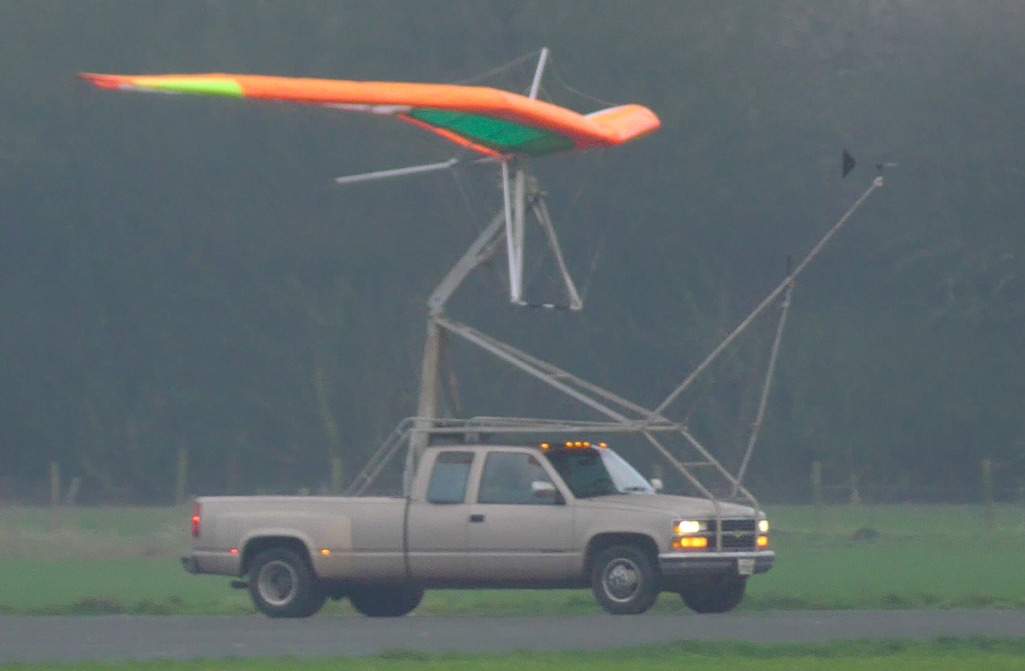
When we rigged it up at the, we went to the airfield for testing. So this is a, a, small airfield, old Cold War, disused Cold War air base used for general aviation now up in North Yorkshire. And that's where the BHPAs test rig is. So this is like a big American pickup truck, big Chevy V8 thing with a frame on the back of it. And you put the glider on the back and then race down the runway and try and put some load on it and measure the forces.
yeah, so, so we got out, we, we, we'd gone there to test the Puma DHL. So we did the day testing with that. It was March. So we didn't have a huge amount of daylight, but there was just about enough time that we reckon we could get a few runs in on the wildcat as well that we brought along. So we get this out and start rigging it, which as I say, it's a bit of a plumber and, yeah, they kind of technical officer there and the guys around, but it was, it was getting a bit of a sort of,
out around it, sort of looking at it and you get all the jokes about, have you stuck the plans together wrong or something? It looks weird. But then actually you load it up on the vehicle and you start driving down the runway and it sort of fills with air and takes its shape. it actually started to look good. Suddenly people were like, yeah, yeah, that actually kind of looks a bit more believable now. Yeah, sure.
gavin (48:00.89)
Yeah.
Tim (48:22.248)
I don't know if this is, does it work if I show you a video clip this.
gavin (48:26.884)
Yeah, I mean I'll see it. The the the show releases audio, but I can I c yeah, this is the this is the truck.
Tim (48:32.628)
Yeah, so that was, there's the truck driving down the runway. You can see the... Yeah, you can see...
gavin (48:36.622)
This is very Mitch McAlliar for me. He showed me videos of this back in the day when they were testing for the stuff where UP
Tim (48:42.154)
Yeah, so yeah, you can see it's nearly dark as well as the headlights roll on the truck. It's sunset. But yeah, it's it doesn't it doesn't look like a normal hang glider.
gavin (48:45.603)
Yeah.
gavin (48:49.306)
All right, those of you listening, I'm just watching a truck scream down the road with it. Yeah, it looks it looks similar. Very similar, but it's just cut differently. That looks cool. I I'm imagining Tim when you were explaining that, thanks for sharing that. That was cool.
Tim (49:00.907)
Yeah.
gavin (49:08.868)
When you're explaining that I was kind of imagining, you know, watching big predators, falcon or something or a hawk. And, you know, when they fold up and dive, it's just you know, we all go
I mean, and you guys can pull bar and you you can do that much, much, much better at or much more similarly to a bird than than we can flying paragliders, but is that kind of canopy possible? Is that also kind of what you're th I mean, could you could you build a wing that could fold in? I don't know that you'd want that so much for XC. I mean, you'd want that for for aerobatics, you know, for just generating massive amount of speed, but
Tim (49:47.646)
I know.
Yeah, for sort of like a wingsuit type thing.
gavin (49:55.202)
Yeah, you just you know pulling in your wing.
Tim (49:58.221)
I don't know. don't think, mean, just sort of, you've kind of caught me on the hop here. This isn't something I've thought about, of course. I, I'm trying to see what the use case would be. I mean, one use case would be like a wingsuit that you could land on your feet because if you could increase the wing here, mean, yeah, I've kind of thought a little bit about variable wing area from the point of view of landing, because one of the issues with hand-gliding is landing as well. And because we do land fast.
gavin (50:25.37)
Sure. Yeah.
Tim (50:26.964)
And so if you could increase the wing area when you come into land, you'd be able to have an easier landing and then reduce the wing area when you're in the air. So it's less wetted area. So you've got more, more speed when you're on glide. It's, it's not something I've been able to work out any kind of a clean engineering solution for. Flaps is something else I'm looking at actually, which, which should help with landing.
But that doesn't change the wing area. The type of flap I was looking at doesn't change the wing area. I was trying to work out a way that you could... Big airlines have what's called Fowler flaps, which are the train that the wing extends backwards to increase the area when they land it. But that's not very easy thing to do with fabric. Actually, one thing you said earlier about the crossover between the kayak, like sailing or kayaking...
gavin (50:57.85)
Sure.
Tim (51:22.344)
optimisation and also with the bird tucking its wing in to go fast. Well, this is, it's sort of, it's actually a misconception that a lot of people get think, or it's a kind of mistaken focus on aircraft design is that they're just looking, that's the parasitic drag term that you're focusing on there. And they get very fixated on that. But one of the critical, the critical difference between a plane and a boat,
or even a hawk diving is that the plane has to generate lift. The boat floats naturally anyway and the hawk when it's diving, it's like plummeting out of the sky. It's not generating any lift at that point. So then they're just about minimizing the parasitic drag and going as fast as possible and the parasitic drag is all that matters there. Whereas for any aircraft that's in steady state, even when you're flying fast,
gavin (52:06.776)
Any lift. Yeah, you don't have right.
Tim (52:21.312)
you're still, your lift has to equal your weight by definition at any stage. So it's not a question of cutting drag, like just looking at cutting drag by itself. What you're looking at is the most efficient way to generate the lift. So generating the lift you need to generate while doing the lowest drag.
gavin (52:38.392)
Are you lived?
gavin (52:46.68)
Yeah, now so now I'm on the other side of the boat, the the mast part with the sail. And and that's exactly what we're doing when we're sailing is we're we're creating lift. You need the little telltales working together, you know? Leward and windward.
Tim (52:51.712)
Hmm. That's that's like the yeah.
Yeah, and it lets you go closer.
Yeah, so the equivalent is when you're trying to cut close into the wind on a sailing boat, closer, the more efficient your sail is, the closer you can get to the wind.
gavin (53:09.284)
More yeah, close hauled is what you're trying to yeah, gotcha. fascinating, Tim. Let's let's end this with I'm gonna completely depart from everything I've just asked you. I haven't asked this one in ages, probably been years, but I used to ask this to e everybody kind of right at the end. If you could rewind the clock to let's see.
I used to say your fifty hour self, but I'm trying to think in terms of your you know, you were flying PGs in the early two thousands and then hang gliders in twenty thirteen. I don't know. Let's go to th yeah, let's do fifty hour self. You can rewind the clock to your fifty hour self and but you know everything you know now. What would you tell that fifty hour self?
Tim (53:55.253)
I think the...
gavin (53:56.311)
This could be life too. I'll I'll give it if total freedom here. This could be about life or this could be about flying.
Tim (54:02.326)
Well, I kind of wish I got into hang gliding a bit earlier because I think I would be a better pilot if I'd been doing it since I, if I started it when I was 20 rather than starting it when I was 30, then I think, I think I'd be, I'd have the other aviation experience, but I think if I'd started hang gliding, I'd be better. I think the, the doing my first comp was really useful because it's just that kind of structured, that you've got a goal when you're flying, you're not just flying sort of.
like floating around, actually, you've got, you've got an objective. So it really improves your flying. So I'd recommend, I'd recommend doing comps early because certainly in hang gliding, they're very friendly. It's not, it's not so much about like winning the competition. It's more, it's more just like joining in, getting good flights. And it's a good way to learn and to improve a lot.
gavin (55:00.739)
Actually I have one more question for you. That was good. But the i in your world, as I understand it, and I'm sure I'm missing a lot of names, but you you know, you've got the you know, the the the kind of heavy guns in the in the competition, you know, for a long time it was Manford Groomer and and you know, now these day Alec Alex Ploner and Christian Czech and I've had Christian on the show. I haven't had the other stuff. I've been trying to get Manford on for ages. Well that'll happen in here at some point, but why are they different?
What makes them so uniquely good?
Tim (55:34.507)
Well, if we knew that, then if I knew that I'd probably be a much better pilot.
gavin (55:36.988)
I mean, we've got the same thing in paragliding. You know, we have you know, when you look at the top ten, it's just it's almost always the top the same top ten. I mean, there might be a little juggling around there, but it's just, you know, their 1% is is always 1%. It's, you know, everybody in the whole comp is really good at a World Cup level, but they're you know, there there's there's something about those top few that have
They've they've got this constant edge.
Tim (56:07.817)
Yeah, and I think it's just lot of it. It's having the edge at every point and just consistently being able to like be that little bit better at maximizing everything because I flow in with both Manfred and Christian in La Venno. So we had the sports class world championships and I was there for that.
gavin (56:18.819)
Little bit, little bit.
Tim (56:34.515)
Yeah, another thing about hang gliding is because it is such a small sport, like even if you're not a sky god, you often do get to fly with the sky gods. and yeah, mean, would all Manfred and Christian, they would always be top of the stack at the start and you just would find you couldn't quite get up to them. And I suspect I probably, I think, I think our gliders have a very good sync rate and quite often I'm able to stay up in lighter lifts than
people around me. I just couldn't quite, it wasn't a lighter difference. just couldn't quite, and trying to like follow Manfred in a thermal, he was never circling, like going around a constant circle. Every bit was sort of like a little bit, sort of like pushing out a little bit in here, out there kind of a bit and just exactly, yeah. And that just let him be so that at the start he'd be in that position of being maybe only 50 feet above.
gavin (57:23.407)
Milking every little piece of it. Hmm.
Tim (57:33.371)
the next person in the stack, but being at the top of the stack and the whole way round, if you're able to just keep that up and just keep that little bit, I mean, on climb is it's a lot of it. Like just being able to be able to find those, those little bits. And the other thing is making the right decisions, just like going, going to the right places. I'm reading the sky, reading the ground.
gavin (57:57.436)
I'm sure in your sport it's it's like in our sport, there's you know, our one of our kind of legend heroes is is Russ Ogden, you know, also a Brit. And you know, and he works down at at Ozone in front in southern France, where you're talking about and he Yeah. Amazing pilot, you know, world champion, and but he's his whole thing is discipline. And I'm sure that's the same in lighting too. It's just just
Tim (58:12.017)
Yeah, he was out. He was one of the test pilots. He was one of the test pilots of Chassis 2 last autumn actually.
gavin (58:24.271)
Discipline. Be disciplined. Don't get emotional. That's a really hard one for me. I'm too emotional.
Tim (58:31.711)
Yeah, yeah, I think that probably is. And being able to, yeah, being able to, one thing I've found is, is having a plan, but then knowing when not to stick to it. So if you don't, if you, if you don't have any plan when you take off, then that's, that's bad. Like you, you won't, you won't get anywhere. But at the same time, if you, if you've got this very rigid fixed idea of what I'm going to do, and then you get in the air and you find that the air isn't what you expected.
gavin (58:43.664)
Yeah.
Tim (58:58.283)
You have to change. you're constantly sort of, you're constantly trying to plan, but you're also constantly like not following the plan when it, when you need to not follow it.
gavin (59:09.155)
Yeah, and the trick is knowing when. Both ways. Yeah. That's the hard bit. Yeah. unfortunately we just can't migrate their brains into our brains, can we? Tim, thanks man. I really appreciate this. It's it's fun talking to somebody with such different expertise than than mine and I wish you the biggest luck with this
Tim (59:11.785)
Hmm. Yeah, that's that's a hard bet.
gavin (59:35.548)
sounds like really fun challenge, but also I'm sure very difficult challenge. But I think we'd all like love to see more hang gliders in the sky. They are just the coolest aircraft. And we none none of us claim that ours are as cool as yours. They're you know, flying prone is definitely where it's at. So I I but yeah, I appreciate you. Thank thanks for taking on this work and plugging away.